The Art of the Shower Guides & advice
Laundry bathroom: how to fit a washing machine next to the shower
Laundry bathroom with a shower: how to place the washing machine and dryer, distances, splashes, humidity from drying laundry and made-to-measure shower enclosures.
In November the washing machine runs more often and laundry hung out on the balcony no longer dries. In many flats everything ends up in the same room: the washing machine under the window, the drying rack open in front of the washbasin, the shower half a metre away. A laundry bathroom almost always starts like this, out of necessity, and it only works well if someone has decided in advance where everything goes.
In a laundry bathroom the washing machine and the shower can sit side by side without any trouble. All it takes is a few carefully measured centimetres, a socket in the right place and an enclosure that keeps the water inside the shower.
Laundry bathroom: where to start
There are two different situations. In the first, the bathroom already exists and you are looking for a spot for the washing machine, perhaps after a move or because there is no room left in the kitchen. In the second, you are renovating and can decide from scratch how to set up a laundry area in the bathroom.
Either way, the starting point is the connections. A washing machine needs its own cold water tap, a trapped waste outlet and an electrical socket. If they are already in place, the layout of the laundry bathroom is built around them. They can be moved, but the waste pipe has to keep its fall towards the stack, and that often means opening up the floor or a wall. Better to know this before falling in love with a layout.
The second thing to check is the free wall. A standard washing machine is about 60 cm wide and 60 cm deep; slim models go down to 40-45 cm deep, which helps when the bathroom is narrow. With a tape measure in hand you can see straight away which of the layouts below will work.
Bathroom with washing machine and shower: three layouts that work
Washing machine in line with the shower
This is the most common solution in rectangular bathrooms: shower tray at the end, washing machine right next to it, on the same wall. It works if the side of the enclosure facing the washing machine is a fixed glass panel and the shower entrance is on the opposite side or at the front. That way the washing machine stays protected and whoever steps out of the shower does not drip onto the control panel. In a long, narrow laundry bathroom it is often the only layout that keeps the passage clear.
The washer-dryer stack
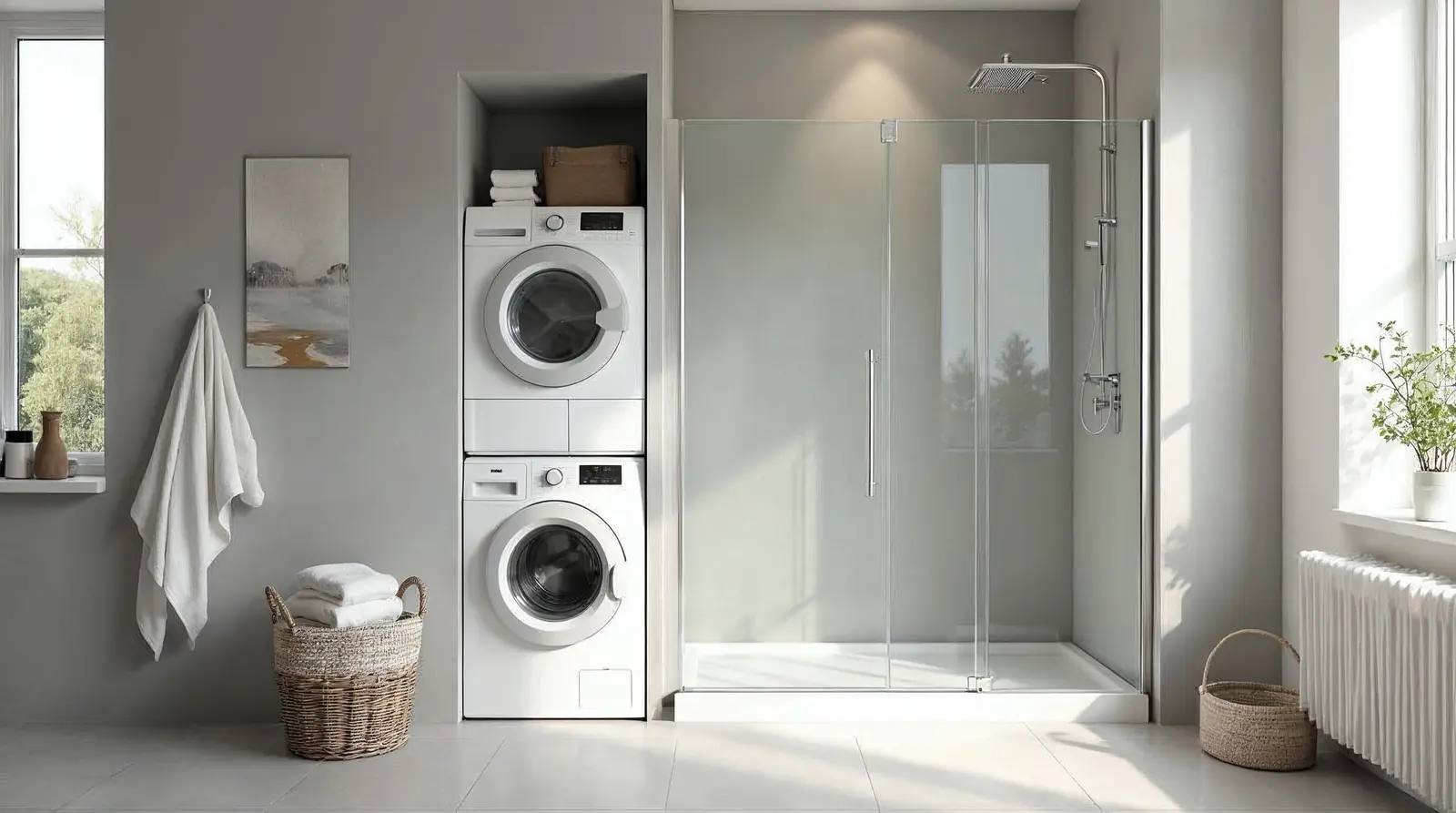
When floor space is tight, go vertical. The tumble dryer is mounted on top of the washing machine with a stacking kit, and the column takes up the same 60x60 cm footprint. A niche next to the shower or a tall cabinet with doors hides it completely. For a laundry bathroom a heat pump dryer is the better choice: it needs no hose to the outside and collects the water in a tank or sends it down the drain, instead of releasing it into the room.
Washing machine under the washbasin worktop
A single worktop running over the washing machine and holding the washbasin turns two bulky items into one. The top should sit a few centimetres above the machine to let air circulate and absorb the vibrations of the spin cycle. With a slim model, even a 5 square metre bathroom with a washing machine can fit a shower, washbasin and WC without feeling like a storage cupboard.
Distances to respect in a bathroom with washing machine and shower
The first space to guarantee is the one in front of the door of the drum. To open it, load the basket and bend down you need about 60 cm of free space. If the shower door also opens into that area, one will end up banging into the other.
Then there is the electrical system. The Italian wiring standard CEI 64-8 divides the bathroom into zones around the shower: zone 2 extends up to 60 cm from the edge of the tray, and ordinary sockets are not allowed there. The washing machine socket therefore goes beyond that distance, protected by a high-sensitivity residual current device. The same zones apply to the radiator, and we explained them in our heated towel rail guide. In any case, position and connection are decided by a qualified electrician.
Finally, the passage. Between the front of the washing machine and the washbasin or WC opposite there should be at least 60-70 cm, otherwise the laundry bathroom turns into an obstacle course every time you hang out a load.
One last point concerns vibration. During the spin cycle a badly levelled washing machine shifts a few millimetres with every wash and, over time, can creep towards the enclosure or the washbasin. In a laundry bathroom it pays to level the feet and stand the machine on an anti-vibration mat, leaving a couple of centimetres free on each side.
Protecting the washing machine from shower splashes
In a laundry bathroom the shower curtain is the first thing to go. It moves, lets water out at the sides and, with every shower, wets the floor exactly where the washing machine stands. Water on the floor and the machine's feet do not mix, and neither do water and the control panel.
A glass enclosure that closes every open side solves the problem at the root. If the shower sits between two walls, an alcove shower enclosure is the obvious choice: CSA makes it in 55 models, with tempered glass 4, 6 or 8 mm thick and heights up to 200 cm. In a laundry bathroom the opening is what matters most:
- sliding doors stay within the footprint of the shower and do not hit the washing machine or dryer next to it
- folding doors fold back against the wall and suit spaces where there is little room in front
- hinged doors give the widest access, but only if 60-70 cm stay free in front of the enclosure and the washing machine is not in their path
The glass plays its part too. With anti-drip glass the water forms compact drops that slide away, the glass stays dry for longer and, in a room already full of moisture, fewer streaks and less limescale build up. A quick pass of the squeegee after the shower is all it takes.
Drying laundry indoors in winter: humidity in the laundry bathroom
A load of laundry hung up to dry releases roughly a couple of litres of water into the air. If the drying rack stays open in a bathroom with a washing machine and shower, that water adds to the steam from the whole family's showers. The result shows within a few days: fogged-up windows, ceiling corners turning dark, silicone around the tray going grey.
A few habits help a lot:
- hang the laundry after the last shower of the evening, not before
- open the window for a few minutes several times a day, even when it is cold outside
- leave the extractor fan on for longer in a windowless bathroom
- do not cover the radiator with wet laundry, because it heats the room less and the moisture stays
If the laundry bathroom has to dry several loads a week, a dehumidifier or a heat pump dryer makes the difference. We have gathered causes and remedies in our guide to bathroom humidity, with advice on ventilation and extractor fans.
Small laundry bathroom: a made-to-measure shower enclosure saves space
In a small laundry bathroom it all comes down to a few centimetres. Take a 160 cm wall with a 100 cm shower tray: that leaves 60 cm, exactly the width of a washing machine, without a centimetre of air around it. With a 90 cm tray the space is there, but only if the enclosure follows the real size of the alcove and not that of a standard model.
This is where a made-to-measure shower enclosure becomes the key. CSA builds it in its own factory in Settimo Torinese to the real dimensions of the space, compensating for walls that are out of square or out of plumb with adjustment profiles. An 88 cm alcove stays an 88 cm alcove, with no gaps to fill with silicone and no centimetres stolen from the washing machine. The same goes for a laundry bathroom in an attic or under the stairs, where walls are rarely straight.
Before asking for a quote, measure the width of the shower space at three points (at the bottom, at one metre and at the top), note where the washing machine's drain and socket are, and take a photo of the room. With this information a CSA dealer can suggest the right enclosure for your bathroom with washing machine and shower and prepare a free quote.
Frequently asked questions
Can you put the washing machine in the bathroom next to the shower?
Yes. The socket must be outside zone 2 as defined by the CEI 64-8 standard, so more than 60 cm from the edge of the tray, on a circuit protected by a residual current device. The shower should be closed with a glass enclosure, with a fixed panel on the side facing the washing machine.
How much space does a small laundry bathroom need?
Besides the shower, washbasin and WC, you need about 60x60 cm for the washing machine (40-45 cm deep with a slim model) and about 60 cm of free space in front of the drum door. With a washer-dryer stack the footprint on the floor stays the same.
Laundry bathroom or washing machine in the kitchen?
It depends on where the connections are and how much space there is. In the kitchen the washing machine takes room away from cabinets and the dishwasher, and dirty laundry passes close to food. A laundry bathroom keeps the whole cycle together, from the laundry basket to the drying rack, as long as humidity is well managed.
Can you dry laundry in a bathroom with a shower?
Yes, if the room is ventilated. It is best to hang it after the showers, open the window often and use an extractor fan or a dehumidifier. A closed enclosure with anti-drip glass limits the water left on the floor and walls.