Heated towel rail: how to choose the right one for your bathroom
A heated towel rail exists to solve a very real problem: the icy floor at seven in the morning as you step out of the shower in January, when the rest of the house has been warm for an hour. It is not just a better-looking radiator. It has to work with the wall space you have, the output your bathroom’s volume needs and the style of the rest of the room, shower enclosure included.
This guide shows you how to find your way through sizes, watts and models, with the practical criteria that really matter when you are choosing the right one for your project, whether it is a complete bathroom renovation or simply swapping out an existing radiator.
Heated towel rails: what they are and which types exist
A heated towel rail is a radiator designed to warm the room while also drying towels and bathrobes on its horizontal bars. There are three main families.
The plumbed-in (hydronic) model connects to the home’s central heating, just like a traditional radiator. It is cheaper to install if the pipes are already in place, but it only heats up when the boiler or the main thermostat is on.
The electric model works with an internal heating element and a power supply, independently of the home’s heating system. It is the most common type in bathrooms renovated separately from the rest of the house, because you can switch it on and off whenever you need it, even in spring and autumn.
The dual fuel model combines both technologies: it runs on the central heating in winter and switches to electric in the months when the radiators are off, so your towel is warm even in May. Anyone renovating from scratch usually weighs up all three options before deciding.
Bathroom space: the measurements to check before you choose
Before buying a heated towel rail you need three measurements: the width of the free wall, the height available under a window or mirror, and the minimum distance from the shower enclosure or bath, usually at least 60 centimetres to leave room to move.
In small bathrooms, a corner model or a narrow column between 35 and 45 centimetres wide is still the most practical option: it takes up little wall and keeps the area in front of the shower enclosure clear. In larger bathrooms, a horizontal radiator up to 100 centimetres wide heats better by spreading warmth over a bigger surface.
A common mistake is choosing a heated towel rail before measuring, guided by looks alone. The result is often a unit too wide for the actual wall, which ends up narrowing the way to the shower or the basin. It is better to sketch the wall on paper, with the real measurements, before falling in love with a model in a showroom.
It is also worth checking the fitting height. Between 1.20 and 1.40 metres from the floor is the most comfortable range for taking a towel without bending, and it remains the reference measurement given by almost all heated towel rail manufacturers in Italy, except for special cases such as bathrooms for people with disabilities.
Heated towel rail: how many watts your bathroom needs
Output is where people most often go wrong. An undersized radiator will not heat the room, however beautiful it looks.
The rule of thumb used by installers starts from the volume of the room: height by width by depth, in cubic metres. For a bathroom with a standard 2.70-metre ceiling, you multiply the volume by a factor ranging from 35 to 45 watts per cubic metre in well-insulated homes, up to 50–55 in older homes or those with cold external walls. An 8-cubic-metre bathroom therefore needs a heated towel rail of between 300 and 450 watts to reach a comfortable temperature even on the coldest days.
If your bathroom has a very large or doorless shower, where warm air escapes more easily, aim for the top of this range, or consider a second heat source near the shower enclosure. Underestimating this calculation is the most common reason a new radiator disappoints, not the brand or design chosen.
Electric or plumbed-in heated towel rail: choosing based on your heating system
The choice between electric and plumbed-in depends less on taste and more on the system you already have at home.
If the heating pipes already reach the bathroom, a plumbed-in model is almost always the cheapest choice: no electrician, no new socket to fit, just a connection to the existing pipes. If instead you are renovating a bathroom that had no radiator before, or you want to use the heated towel rail when the rest of the radiators are off, the electric version avoids chasing new channels into the walls for pipes and turns on with a switch or timer, independently of the rest of the system.
The dual fuel model remains the middle ground for anyone who wants the best of both, in exchange for a higher purchase price.
Heated towel rails and safety: the electrical zones you need to know
For an electric or dual fuel heated towel rail, the position of the socket and the unit’s protection rating are not details to leave to the installer without checking.
In Italy, the CEI 64-8 standard, section 701, divides the bathroom into safety zones based on the distance from the shower and bath. In zone 1, the closest to the water, electrical appliances must have a high protection rating; in zone 2, just outside it, the minimum required is IPX4. An electric model must therefore be positioned and powered in line with these distances, with a dedicated socket and a suitable RCD. Full details on the zones and required IP ratings can be found in the Impianti News guide to CEI 64-8 section 701 (in Italian).
A qualified electrician always checks the exact distance from the shower enclosure before fixing the socket, because a few centimetres can change the safety zone and the protection rating required.
Heated towel rail: matching it to your bathroom style and shower enclosure
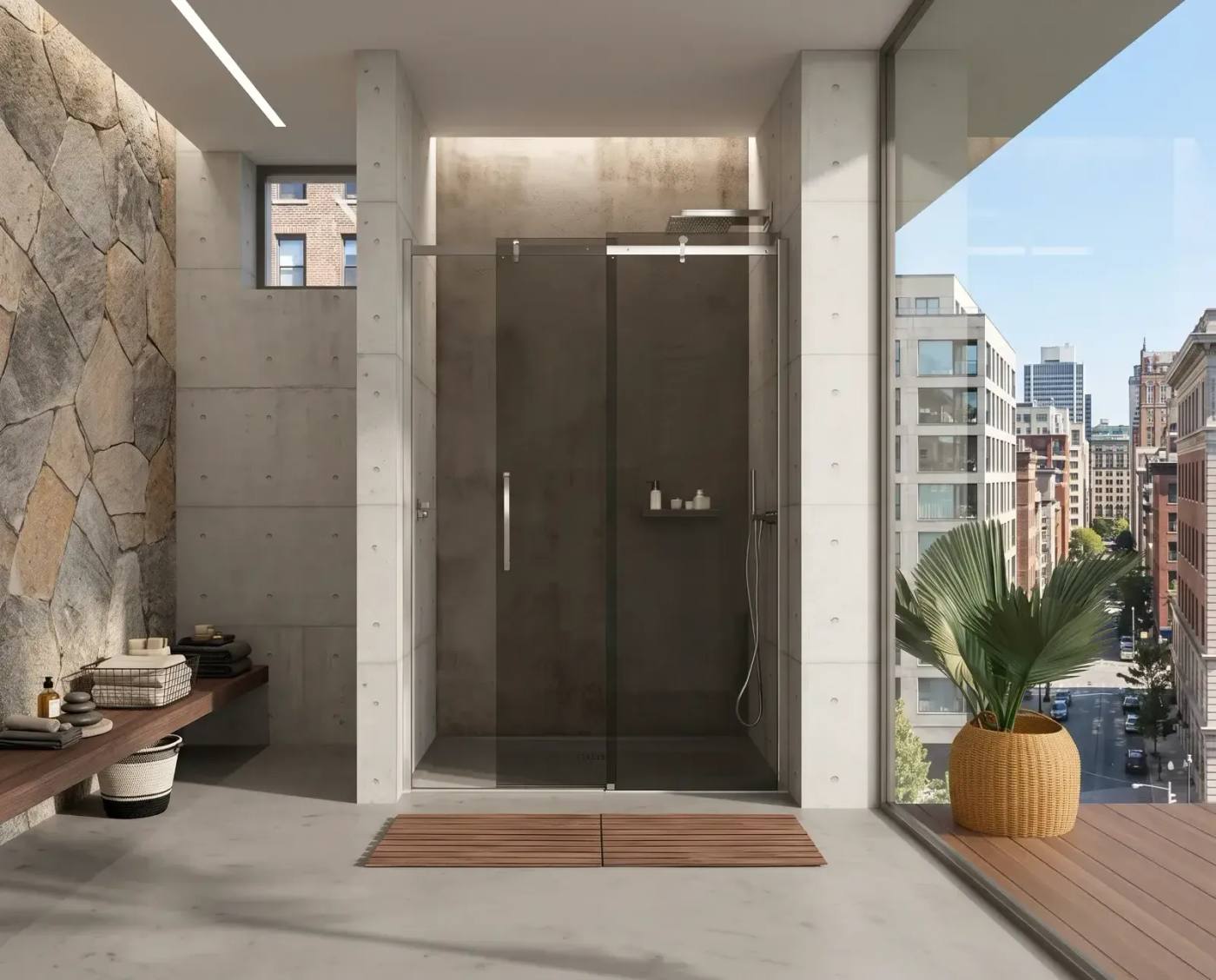
Today’s heated towel rail is no longer just glossy white. The most requested finishes are anthracite, matt black and bronze or champagne tones, the same palettes you find on the profiles of the latest shower enclosures.
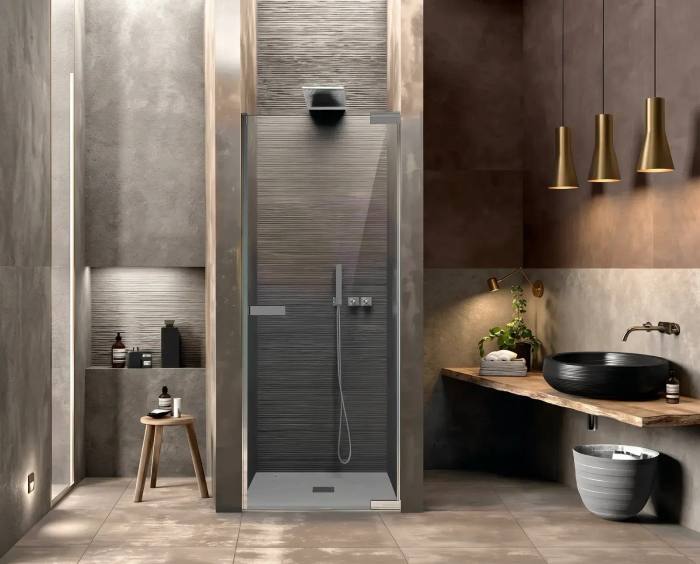
In a dark, textured bathroom, a black or anthracite radiator blends into the walls and lets the lighter elements stand out, such as the shower tray or sanitaryware. In a lighter, minimalist bathroom, a white or chrome model remains the safest choice, while warm finishes such as bronze and brass work well in more natural or textured bathrooms.
The simplest approach is to choose the unit together with the room’s other metal elements: taps, shower enclosure profiles, accessories. They do not need to be identical, but a consistent tone makes the bathroom look more polished with minimal effort, and that applies both to a new project and to a simple radiator swap in a bathroom that is already furnished.
How to choose the right heated towel rail for your project
Before deciding, it is worth checking four points:
- the free wall space and the minimum distance from the shower enclosure or bath
- the output in watts, calculated on the bathroom’s real volume, not just its floor area
- the type of system already in place, to choose between plumbed-in, electric or dual fuel
- the electrical safety zone and the IP rating required, if the unit is electric or dual fuel
The right heated towel rail is one that fits into the overall design of the room, not an accessory picked separately at the last minute. If you are already weighing up the size and finish of the radiator, you are probably looking at a new shower enclosure too, and it is worth sorting out both at the same time, with the same finishes and the same dimensions in mind.
If you would like a detailed, honest assessment of the shower enclosure for your renovation project, you can request a CSA quote with the measurements you already have in mind, or talk it through directly with one of our experts before settling the final details.
FAQ
How much does a heated towel rail cost?
An entry-level electric model starts at 150–200 euros, installation excluded. Mid-range plumbed-in models, with special finishes or larger sizes, easily reach 400–600 euros. The price rises with output, length and special finishes such as matt black or brass.
Does an electric heated towel rail use a lot of electricity?
It depends on how you use it. A 300–400 watt electric model, switched on for a couple of hours a day in the cold months with a timer, has modest consumption, comparable to some everyday household appliances. Consumption rises if it stays on all day without a thermostat or timer.
Plumbed-in or electric in a recently renovated bathroom?
If the heating pipes were already brought into the bathroom during the renovation, a plumbed-in model is cheaper to install. If instead you want to use the heated towel rail in spring and autumn, when the rest of the radiators are off, electric or dual fuel remains the more flexible choice.