Enclosing an Existing Walk-In Shower: Add a Glass Panel or a Technical Curtain?
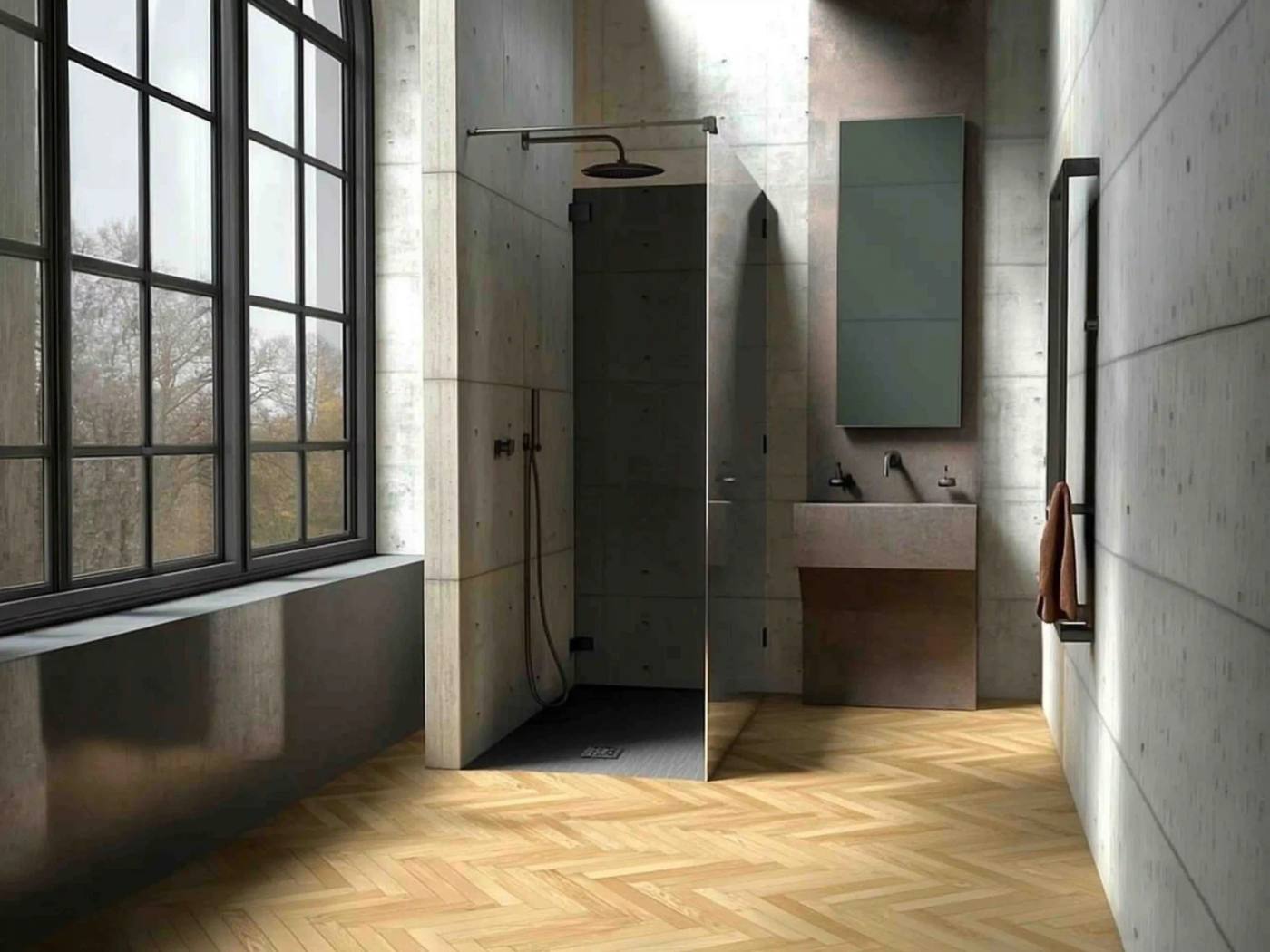
You have a walk-in shower, and after a few months you have noticed a problem that seemed trivial at first: water splashes everywhere. On the floor, up the wall, across the bathroom window. Every time you step out you find yourself mopping up in a way you had not bargained for. Enclosing an existing walk-in shower then becomes a practical priority, not a cosmetic whim.
The good news is that you do not have to dismantle everything. There are two main solutions that let you intervene without touching the shower tray or the tiles: add a glass panel or fit a technical curtain. Both work. But not for every case, not in the same way, and not with the same end result.
Why people decide to enclose an existing walk-in shower
The walk-in began life as an open solution, with no doors or barriers. Its strength is immediate accessibility and a clean look that works best in large bathrooms with high ceilings and good ventilation. But in the average bathroom — often compact, with moisture that is already tricky to manage — an open walk-in creates a few practical issues.
Enclosing an existing walk-in shower mainly answers three needs:
Containing splashes. Even with a rain head positioned correctly, water that bounces off the body easily travels beyond the shower perimeter. In a small bathroom, the surrounding surfaces start to suffer within a few months.
Thermal comfort. An open shower loses heat much faster. In winter, even with the heating on, you feel the temperature difference between inside and outside the enclosure. Even a partial barrier makes a noticeable difference.
Managing moisture. Without a barrier, steam spreads through the whole bathroom. Anyone with mould on walls or ceiling often sees a real improvement after enclosing the shower at least partially.
Enclosing an existing walk-in shower with a glass panel
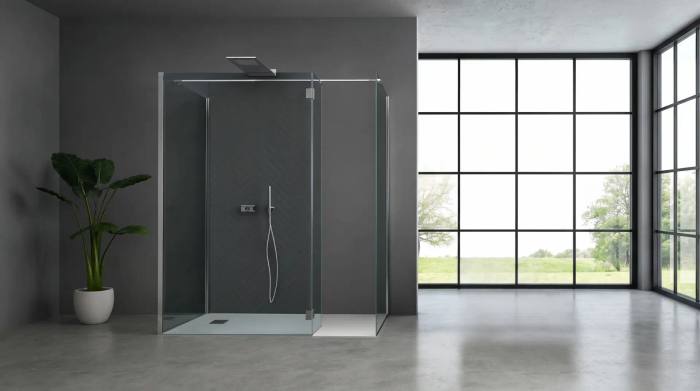
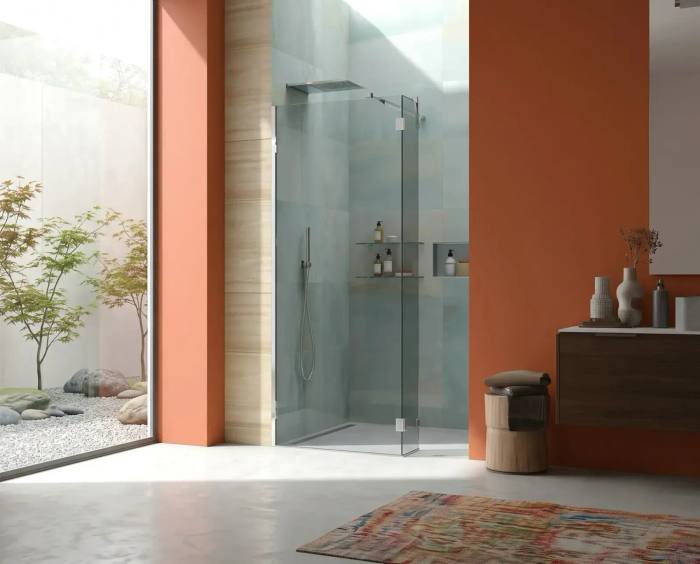
A glass panel is the more permanent solution and the one that changes the look of the bathroom most. In essence, it turns the walk-in into a true shower enclosure by adding one or more fixed or sliding panels along the opening.
When it makes sense
It makes sense when the walk-in has a regular opening, with well-aligned perpendicular walls, and when there is room for the panel to open without obstruction. If the shower sits in a corner with standard dimensions (80×80, 90×90, 70×120 and the like), adding a panel is almost always feasible.
Those who want to enclose an existing walk-in shower permanently, without sacrificing the look, often choose this route precisely because the result rivals a brand-new enclosure.
Types of panel
Pivot door. Rotates on a central or side hinge. Needs clearance in front of the shower to open. Elegant, suited to bathrooms with enough room.
Sliding door. Glides along a track. Needs no swing space. Ideal when the bathroom is narrow or the shower sits close to a basin.
Fixed panel with a walk-through gap. No movement at all: you enter from the side through an open space. Works well when splashes mainly come from the side opposite the entry.
Materials and thicknesses
To enclose an existing walk-in shower with a lasting result, toughened glass is the only correct choice. The minimum recommended thickness is 6 mm for fixed panels and 8 mm for large pivot doors. 10 mm glass offers remarkable solidity but adds weight, which can complicate fitting to certain wall types.
Support profiles are typically aluminium (chrome, satin, black or bronze finish) or stainless steel. The choice of finish has a big say in how well it blends with the rest of the bathroom.
Enclosing an existing walk-in shower with a technical curtain
The technical curtain is often underrated, mentally filed alongside cheap or temporary fixes. But curtains designed specifically for modern showers are another category altogether: technical fabrics, solid fixings, and a design built to last.
When it makes sense
It makes sense when the walk-in opening is irregular, when the walls are not perfectly straight, or when you want a reversible solution with no structural work. It also makes sense for renters who do not want permanent changes to the setup.
Enclosing an existing walk-in shower with a technical curtain is also the quickest route: no millimetre-precise measuring, no drilling into the tiles (with tension systems), and it goes up in an afternoon.
What sets a technical curtain apart from an ordinary one
The fabric is the first factor: technical shower curtains are made from high-density polyester with an anti-mould treatment, or from PVC-free PEVA, which offers greater durability and no odours. The fabric is often twice the thickness of a standard curtain.
The fixing system is the second. A quality telescopic rail, with non-slip rubber ends and an adjustable pressure-lock, holds firm for years. Some solutions use wall fixings with plugs, for those who prefer something more stable.
The ideal technical curtain for enclosing an existing walk-in shower also has enough weight to hang straight without billowing in the water flow, a weighted hem or a magnetic guide that keeps the edge tight against the tray, and a generous width that allows proper overlap with the walls.
Head to head: panel or curtain?
Setting the two solutions side by side helps you see which suits you. And on a close look, it is hard not to notice that on almost every front that truly matters, the glass panel has little to envy.
Splash control: the panel wins clearly. Well-fitted glass with quality seals lets not a drop through. The curtain reduces the problem but does not solve it: at the sides, along the bottom, wherever the fabric does not sit flush against the wall, water always finds a way through. With a flush-to-floor tray, the curtain becomes almost useless along the lower edge.
Visual impact: no contest. A panel of extra-clear toughened glass with a matt black or satin steel profile is a piece of furniture in its own right. It blends with the rest of the bathroom, sets off the tiling, and keeps the visual lightness of the original walk-in. A curtain, however well chosen, introduces a textile element into a space that is mostly meant to be all hard surfaces: glass, ceramic, stone. Anyone who has invested in a quality bathroom and wants to enclose an existing walk-in shower without spoiling the look chooses glass, almost every time.
Durability: toughened glass does not deteriorate. The seals need replacing every few years, but the panel itself lasts decades. The technical curtain, however good, is a material that wears: the fabric loses body, the anti-mould treatments run out, the colours fade. Over the long run, glass costs less than it seems.
Day-to-day maintenance: glass wipes clean with a cloth and a degreaser. A thirty-second job. The curtain has to come down, be washed and put back. And where it touches the walls, moisture builds up in ways glass never knows.
Ease of installation: here the curtain has a real edge. It needs no millimetre-precise measuring and no specialist fitter. It is the right choice when you want something immediate and reversible. But if the aim is to enclose an existing walk-in shower properly and for good, ease of installation cannot be the only criterion.
Up-front cost: the technical curtain starts lower. But it is a repeating outlay: on average it needs replacing every two or three years. The glass panel costs more up front, but that cost does not recur. Over a five- or ten-year horizon, the gap narrows until it disappears.
The most common mistakes when enclosing an existing walk-in shower
The first mistake is measuring at a single point. Bathroom walls are rarely perfectly plumb and trays are often not exactly level. Measuring at three different points, both in width and in height, makes the difference between a panel that fits perfectly and one that sits crooked or will not close.
The second mistake is underestimating the seals. A glass panel without adequate perimeter seals does not solve the splash problem; at best it reduces it. Seals should be chosen to match the profile and replaced when they start to lose their springiness.
The third mistake, specific to curtains, is choosing a rail that is too thin or too short. A rail of insufficient diameter bows under the weight of a wet curtain. One that is too short comes loose easily.
The fourth mistake is ignoring airflow. Enclosing an existing walk-in shower reduces internal ventilation. If the bathroom lacks an adequate extractor, the steam that once dispersed through the room now concentrates inside the enclosure. The result, paradoxically, can be more moisture in the wrong place.
What to weigh up before choosing
Before deciding how to enclose an existing walk-in shower, it is worth answering a few concrete questions.
How regular is the opening? If the walls are more than 5 mm out of plumb, a panel needs adaptation work that is not always straightforward. The curtain is more forgiving here.
Does the shower tray have a raised lip or is it flush to the floor? With a flush tray, holding water back at the bottom is harder either way, but with a curtain it is nearly impossible. A panel with a magnetic seal along the lower edge handles this far better.
Does the bathroom have good ventilation? If so, enclosing an existing walk-in shower causes no added problems. If ventilation is poor, it is worth considering an extractor before going ahead.
What are the priorities: looks, practicality or budget? Answering that clearly makes the choice much simpler.
Enclosing an existing walk-in shower: a choice worth getting right
A walk-in left open with a splash problem does not improve on its own. The steam, the moisture, the hours spent mopping the floor all add up. Acting on it, even with something simple like a well-chosen technical curtain, changes the quality of using the shower every day.
If instead you want to enclose an existing walk-in shower for good, with a finish to match the rest of the bathroom and uncompromising watertightness, a made-to-measure glass panel is the right answer.
The difference between a solution that truly works and one that creates fresh problems often comes down to the initial assessment: accurate measurements, the right materials, correct installation.
Need to work out which solution is right for your shower? The experts at CSA Box Doccia can help you weigh up the options based on the real dimensions of your bathroom, the style you are after and your budget. Write or call us: you will find all the details at our contact page.