Walk-In Showers: Everything You Need to Know About a Shower Without an Enclosure

More and more people are looking at a shower without an enclosure as an alternative to the classic cubicle with a door and framing. The reason is simple: over recent years the bathroom has stopped being a purely functional space and become a place to unwind, and the walk-in answers that shift perfectly. Less visual clutter, cleaner lines, a feeling of openness that completely changes the mood of the room.
In this guide you will find everything worth knowing before you choose a shower without an enclosure: how it works, when it makes sense, the advantages and the trade-offs, and which solutions suit each type of bathroom and budget.
What a shower without an enclosure actually is
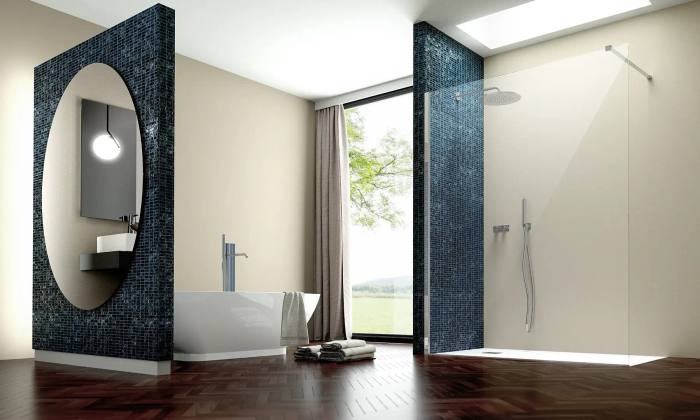
A shower without an enclosure means a shower area with no hinged doors, no sliding panels and no closed perimeter framing. You step straight into the wet area, which is set apart from the rest of the bathroom by one or more fixed glass panels or, in some cases, by nothing at all.
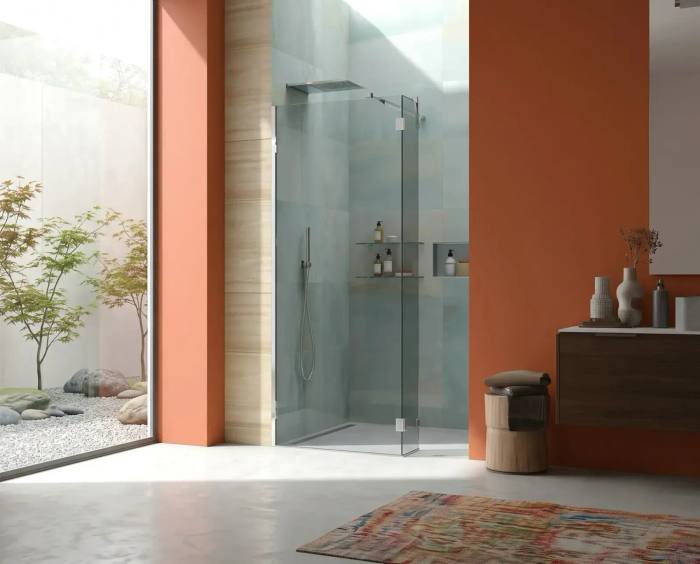
The most common version is the walk-in: one or two sheets of toughened glass, fixed to the wall or floor, that mark out the shower area without closing it off. The result is an open, clean structure that works with the look of the bathroom rather than dominating it.
There is also a more radical version, the wet room, where the whole bathroom is tanked and the shower area has no physical separation at all. That route calls for significant building work, though, and is not always suited to an existing bathroom.
The main benefits of a walk-in shower
Choosing a shower without an enclosure is about far more than looks. The benefits are real and touch both day-to-day comfort and how easy the shower is to maintain.
A greater sense of space. Even in a mid-sized bathroom, removing the doors and framing of a traditional cubicle gives back visual depth. The fixed glass of a walk-in never breaks your line of sight, so the room feels bigger than it really is.
Easier cleaning. Traditional shower enclosures collect limescale on the runners, in the joints, along the profiles and around the hinges. A walk-in with only a few fixed elements cuts back drastically on the awkward surfaces you can never quite reach. A toughened glass panel with an anti-limescale coating wipes clean in seconds.
A contemporary look. The walk-in has become the standard in modern, minimalist bathrooms. Clear or smoked glass panels suit any style, from industrial to Scandinavian, without clashing with the colours you have chosen elsewhere in the room.
Accessibility. A walk-in with a flush shower tray is the best option for anyone with limited mobility, or simply anyone who wants a safe, easy step-in. CSA has built a dedicated range around exactly this idea of barrier-free access: the accessible shower solutions.
Longevity. A well-built walk-in, with quality toughened glass and stainless steel or anodised aluminium profiles, lasts for decades without deteriorating. There are no seals that give way, no doors that drop out of line, no handles that work loose.
When a shower without an enclosure is the right call
The walk-in suits a lot of situations, but it is not always the right answer for every bathroom. Here are the cases where it pays off most.
Bathrooms with at least 80-90 cm of width in the shower area. Below that, a pure walk-in with no return panel tends to let water escape into the rest of the room. Here you can consider a model with a small additional fixed panel that keeps the spray in while preserving the open feel.
Bathrooms that already have a properly tanked floor, or where a refit is planned anyway. Fitting a shower without an enclosure into an existing bathroom without redoing the floor still calls for the drainage and the fall to be handled correctly, points to weigh up with a plumber.
Anyone after a clean, coherent look. If you have gone for large porcelain stoneware floor tiles, full-height wall coverings or wall-hung sanitaryware, a walk-in panel is the natural way to finish the scheme.
Anyone who wants to fine-tune every detail. With a made-to-measure walk-in you choose the glass thickness, the profile finish, whether or not there is a floor profile, and the panel height. It is a solution built around the space, not the other way round.
Shower without an enclosure and shower tray: an essential pairing
A walk-in works best paired with the right shower tray, ideally flush with the floor or with a very low edge. The tray defines the wet area, collects the water and channels it to the waste.
The materials used most often are resin, porcelain stoneware and glass. Each choice behaves differently in terms of appearance, durability and ease of cleaning. CSA offers a broad range of shower trays in resin, stoneware and glass designed to sit perfectly with walk-in structures, with reliable water tightness and anti-slip safety.
A common mistake is to choose the walk-in before the tray and then discover the dimensions do not line up. The right logic is the opposite: start from the space you have, choose the tray that fits the measurements, then design the walk-in structure around those reference points.
CSA walk-in collections: a made-to-measure shower without an enclosure
CSA has built its identity around bespoke design. Every bathroom has different measurements, different geometry and different needs, and a standard walk-in rarely fits them all. That is why the CSA walk-in range includes models in 6 and 8 mm glass, configurations with one or two dividers, versions with an extra fixed return, wall support bars and 180-degree opening.
The two main collections are Gemma and Sabrina. The Gemma collection works with 6 and 8 mm glass and offers a series of configurations: from the single divider (Gemma W.D) to the twin-divider version (Gemma W.A2D), through to variants with a fixed return and a small hinged door. It is a line designed for anyone after simplicity and versatility.
The Sabrina collection uses 8 mm glass and stands out for an even wider range of combined solutions: the Sabrina W.D+L adds an angled fixed return to the main divider, the Sabrina W.DL+F builds in a side panel, and the Sabrina W.DB includes a pivot door. For bathrooms with unusual dimensions or irregular geometry, CSA produces made-to-measure solutions that no standard catalogue product could ever cover.
A shower without an enclosure in a small bathroom: it can be done
One of the most common beliefs is that the walk-in only suits large bathrooms. Not true. With the right configuration you can fit a shower without an enclosure into a tight space too, and the result looks better than any cubicle with a sliding or folding door.
The trick is choosing the right model. A single panel with wall support bars, paired with a compact tray, takes up very little room and needs no door to swing open. In some narrow bathrooms the shower sits along a short wall: here an alcove-style walk-in, with the glass closing off the front, is the most efficient solution.
If you have a corner to make the most of, CSA also offers corner shower enclosures that combine the logic of an optimised corner with the look of a walk-in.
A shower without an enclosure: the points not to overlook
No solution is without things to weigh up carefully. The walk-in has a few worth knowing before you decide.
Spray escaping. With no door, water can leave the shower area if the shower head is badly placed or the pressure is high. The answer is to design the shower area properly (adequate dimensions, perhaps an extra fixed panel) and to use a ceiling head or one with adjustable direction. You can find more on containment options in the section on alcove shower enclosures, which naturally keep the spray in.
Bathroom temperature. In unheated or very large bathrooms, the lack of a door can let warm steam disperse more quickly. Underfloor heating or an efficient heated towel rail solves the problem.
Cleaning the floor. The wet area extends a little beyond the shower itself. This is not a structural flaw but a feature of the open system, and all it asks is the habit of drying the floor quickly after use, or using anti-slip materials with good drainage.
FAQs about the shower without an enclosure
Does a shower without an enclosure cost more than a traditional cubicle?
The cost depends mainly on the quality of the materials and how complex the configuration is. A made-to-measure walk-in in 8 mm glass costs more than a standard catalogue cubicle, but it is comparable to a mid-to-high quality enclosure. Bear in mind that the walk-in, with fewer moving parts, needs less maintenance over time.
Can a shower without an enclosure be fitted without building work?
In many cases, yes. Walk-ins fixed to the wall or floor with profiles do not call for heavy building work. You do need to check that the fixing wall is solid and that the waste is correctly positioned.
How big does the shower area need to be to avoid spray escaping?
The minimum recommended size is around 90 cm wide by 90 cm deep. Below that it is best to add a fixed return or a small door to keep the spray in.
Can I pair a shower without an enclosure with any kind of shower tray?
Yes, but the best result comes with flush trays or ones with a very low edge. High trays create a step that can be awkward and visually heavy.
Does CSA only make walk-ins in clear glass?
No. The CSA range includes glass in several finishes, including smoked glass, which gives more privacy while keeping the open look of a walk-in.