Shower glass thickness: 6mm or 8mm? How to choose
When two quotes arrive for the same shower enclosure, there is almost always just one line that differs: the glass thickness. Six millimetres on one model, eight on another, with a price gap of around 15-20%. Understanding what really changes, without stopping at the number, saves you paying for a feature you don’t need or giving up stability you actually require. Shower glass thickness is not an aesthetic detail: it affects weight, rigidity, compliance with standards and, in some configurations, the safety of the installation.
Why shower glass thickness is not a detail to overlook
A shower enclosure works every day in conditions that few other pieces of bathroom furniture have to endure: constant humidity, temperature swings, and opening and closing repeated for years. The thickness of the glass determines how much the panel flexes under the weight of a hinged door, how much a sliding door vibrates at the end of its travel, and how well the hinge fixing points hold. It is not a decorative parameter but a structural choice linked to the configuration, the size of the panel and the type of opening: a fixed panel one and a half metres wide does not behave like a sixty-centimetre one, which is why the same CSA model, such as Gemma in its walk-in version, is offered in both 6 and 8 millimetres.
Toughened shower glass: the safety behind every thickness
Before comparing 6 and 8 millimetres, one point needs to be clear: both start from the same safety principle. Toughened shower glass undergoes a heat treatment that takes it above 600 degrees and then cools it rapidly, increasing its mechanical strength four to five times compared with ordinary float glass. In the rare event of breakage, toughened glass does not split into sharp shards but shatters into small, blunt granules, like car safety glass. This behaviour is defined by UNI EN 12150-1, the standard that sets dimensional tolerances, flatness, edge work and fragmentation. CSA also tests its range to UNI EN 12150-2:2005, which checks the conformity of the factory production process, as explained on the page dedicated to a compliant shower enclosure.
Shower glass thickness: 6mm or 8mm, a practical comparison
This is where glass thickness proper comes into play, meaning the practical difference between 6mm and 8mm. 6mm glass weighs roughly 15 kilograms per square metre, against around 20 for 8mm: a third more mass on hinges, rollers and profiles. This translates into three concrete differences: rigidity (8mm flexes less and feels more solid), weight in motion (on sliding doors 6mm glides with less effort and less wear on the bearings) and cost (with the same finishes, 8mm costs more in raw material and processing). So there is no single answer, but a choice that depends on how large the panel is and on the type of opening.
When to choose 6mm shower glass
In terms of glass thickness, 6mm is the most common choice in the CSA range and covers most domestic needs: hinged-door models such as Camilla and Alice, the Kalea sliding enclosure, and much of the alcove and quadrant range. It works well on doors and panels of standard size, where the frame and profiles already provide enough support, if the bathroom is of average size, the enclosure slides (the lower weight helps it glide) and there are no very wide fixed panels without side supports. For a standard refit, 6mm shower glass offers the same safety as 8mm, with a real saving on the quote.
When you need 8mm shower glass
8mm becomes the best choice when the glass has to stand on its own, with fewer structural constraints around it: very wide fixed panels, heavy hinged doors, and walk-in configurations with no top rail to stiffen the whole unit. In the CSA range, the Sabrina collection, designed for frameless walk-in panels, is made entirely in 8 millimetres, as are the Alma, Fiorella and Sarah alcove models, which have heavier hinged doors. In these cases 8mm shower glass is not an aesthetic extra but the condition that keeps the panel stable, with no noticeable vibration or flexing.
What about 10mm glass? A standard CSA doesn’t use for shower enclosures
In architectural glazing there is also a 10-millimetre thickness, used mainly in large glass façades or structural partition walls, where the spans are far greater than anything found in a bathroom. CSA does not use it for shower enclosures: the range stops at 8mm, which, combined with made-to-measure design, already covers the most demanding configurations without weighing down doors and hinges. With non-standard panels or unusual layouts, the answer is not to go thicker than 8mm, but to turn to CSA made-to-measure glass showers, which adapt dimensions and supports to each individual room.
Standards: UNI EN 12150-1 and certification of CSA shower glass thickness
Whatever thickness you choose, a shower enclosure must comply with UNI EN 14428, the harmonised European standard that requires tests for cleanability, fatigue resistance over at least 20,000 cycles, stability and watertightness. Compliance is demonstrated by CE marking and the Declaration of Performance, which the manufacturer provides on request. For the glass, UNI EN 12150-1 defines the physical and mechanical characteristics that every shower glass thickness must meet, while UNI EN 12150-2:2005 covers factory production control. A complete project, with CE marking, an up-to-date Declaration of Performance and certifications such as UNI EN ISO 9001:2015, is what distinguishes a compliant shower enclosure from an untraceable product.
Walk-in shower enclosures: why glass thickness matters even more
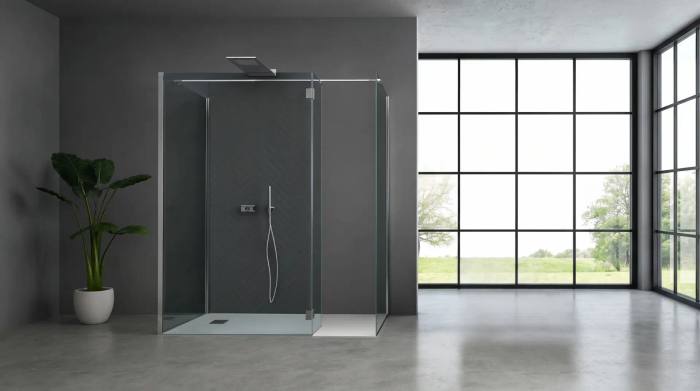
In walk-in solutions, glass thickness becomes an even more decisive variable, because the panel often has no surrounding frame to support it: stability depends almost entirely on the glass and on the wall or floor fixing arms. That is why both thicknesses feature in the CSA range of walk-in shower enclosures: the Gemma collection, with more compact screens and fixed sides, is available in 6 and 8 millimetres, while the Sabrina collection, designed for larger and more striking configurations, is made in 8 millimetres only. The choice between the two depends on the width of the screen and the number of fixing points planned in the project.
Made-to-measure design: who chooses the right shower glass thickness for you
It is not always easy to work out on your own which thickness you need, especially when the bathroom has irregular recesses, out-of-square walls or non-standard dimensions. In these cases, choosing the most suitable shower glass thickness starts with an accurate survey of the space, not a generic table. The CSA made-to-measure glass shower service starts right here: a technician assesses the configuration, the type of opening and the real dimensions of the bathroom, and only then recommends the thickness that best balances stability, weight and budget, so you never have to settle for a standard size that doesn’t fit your space.
Maintenance: why glass thickness also affects spare parts
The glass thickness you choose today also has an impact on future maintenance. Seals, the component most prone to wear in a shower enclosure, have to be selected according to the thickness of the glass, as well as the gap and the shape of the profile: a seal designed for 6mm will not hold on 8mm glass, and vice versa. So when you request assistance or a spare part, knowing the exact thickness of your panel speeds up the whole process. The CSA guide to shower enclosure spare parts and assistance explains in detail how seals, hinges and rollers should also be chosen according to this figure, which is often overlooked at the time of purchase.
Conclusion
In the end, choosing between 6 and 8 millimetre shower glass is not a question of safety, which is identical for both, but of balancing panel size, type of opening and budget. If you are unsure which shower glass thickness best suits your bathroom, the most reliable route is still a made-to-measure survey that takes the real configuration into account rather than a generic table. Contact us today!
FAQ
What shower glass thickness do I need for standard domestic use?
For most domestic bathrooms, with standard hinged or sliding enclosures, 6mm shower glass is sufficient and provides full safety under UNI EN 12150-1. 8mm is only needed for very wide fixed panels or frameless walk-in enclosures.
Is 6mm glass less safe than 8mm?
No. Both are toughened shower glass, with the same heat treatment and the same safe fragmentation principle. The difference lies in rigidity, weight and structural behaviour in the most demanding configurations, not in the level of safety.
Why doesn’t CSA make shower enclosures in 10mm glass?
Because most bathrooms don’t need it: 8mm shower glass, combined with made-to-measure design, already covers the most demanding configurations without the weight and cost of 10mm, which is more common in large architectural glazing than in residential shower enclosures.