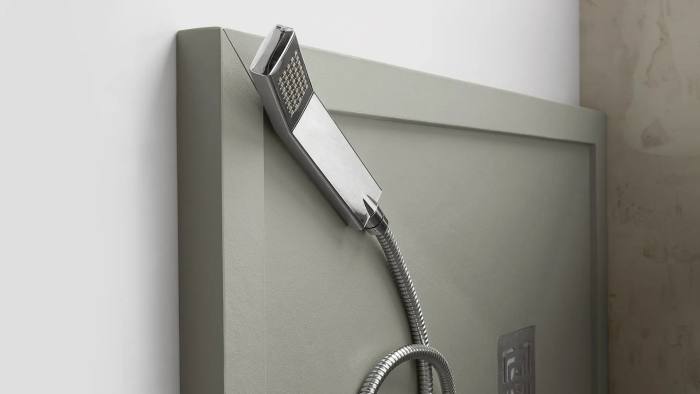
Porcelain shower tray: features, benefits and how to choose

You can spot a porcelain shower tray straight away among the samples in a showroom: it has the same compact surface as the tiles of a modern floor, but it is designed to withstand water, weight and daily use without giving way.
If you are renovating your bathroom and have already chosen porcelain stoneware for the floor and walls, you may be wondering whether to use the same material for the shower tray too, for a seamless look with no visual break between floor and enclosure. The answer depends on what matters most to you: long-term durability, visual consistency with the rest of the bathroom, or a lighter tray that is easier to install. In this guide you will find out how a porcelain shower tray is made, what its real advantages are and what to consider before choosing it over resin.
What is a porcelain shower tray?
A porcelain shower tray is made from porcelain stoneware, the same material used for many floors and wall coverings in the home. The body is made from ceramic clays, feldspars, kaolin and sand, ground into a uniform powder and then pressed into the shape of the tray.
It is fired at between 1150 and 1250°C, for long enough to make the material almost completely impermeable: its water absorption stays below 0.5%, the threshold that industry standards (source: Wikipedia, Grès porcellanato) use to classify porcelain stoneware. This, more than anything else, explains why it does not stain and does not retain moisture over time.
Unlike traditional glazed ceramic, porcelain stoneware has the same colour and structure right through the thickness of the piece, from the surface to the back. A deep scratch does not reveal a different colour beneath a glaze, because there is no glaze here: the surface and the body are one and the same.
The advantages of a porcelain shower tray
The first advantage of a porcelain shower tray is its durability: it does not chip easily, it does not fade in the sun if the bathroom has a sunny window, and it copes perfectly well with the harshest cleaning products, which on other materials leave marks or dull the surface.
Low porosity is its second strong point. Shampoo, bath salts, hair dyes: nothing leaves a mark on the surface, even after years of daily use. This is also one of the reasons why porcelain stoneware shower trays remain a favourite choice in bathrooms shared by several people, where the tray gets dirty and is cleaned several times a day.
Then there is visual continuity: if you have already laid porcelain tiles on your bathroom floor, you can choose the same collection for the shower tray, creating a seamless surface that makes the bathroom feel larger. Porcelain also lends itself well to flush-to-floor installation, provided the thickness and the fall towards the waste are designed correctly from the start.
What to know before choosing: weight, cost and installation
A porcelain shower tray weighs more than a resin equivalent of the same size. This is not a problem when laying it on a solid screed, but it must be taken into account if the tray is to be installed on a raised structure or on a floor with limited load capacity: in that case, talk it through with whoever is carrying out the work before ordering.
Cost is another factor: a porcelain shower tray generally costs more than a resin one of the same size, especially in the more refined finishes or when cut to size. Installation requires a perfectly level screed, because porcelain is a rigid material and, unlike resin, cannot adapt to small irregularities in the substrate.
If you are looking for a lighter material that is easier to install and warmer to the touch in winter, our guide to the resin shower tray offers a useful comparison before you decide.
Porcelain or other materials: how it fits into the CSA range
Porcelain is not the only way to achieve a textured, material look in a shower tray. In our guide to the stone-effect shower tray you will find a direct comparison between composite resin and porcelain stoneware for anyone looking for a surface reminiscent of natural stone, with selection criteria designed specifically for this decision.
If, on the other hand, you are after a warm colour rather than a textured finish, you may like the terracotta shower tray, now made mainly in composite materials, or the black shower tray for a more dramatic effect, available in both resin and porcelain depending on the collection.
Porcelain shower tray sizes and finishes
The most popular sizes range from 80×80 cm for square enclosures up to 90×140 cm and beyond for walk-in showers, but a porcelain shower tray can be cut to size to fit non-standard recesses or renovations with particular space constraints.
As for finishes, the most popular choice today is a textured or matt stone-effect surface, which is not only pleasant to the touch but also helps with safety. Before choosing the finish, it is worth checking the slip resistance class of the shower tray, especially if there are children or elderly people in the household.
Caring for a porcelain shower tray
Cleaning a porcelain shower tray is easier than with other materials: all you need is water and a neutral detergent applied with a non-abrasive sponge, without the specific products that resin requires to avoid damage.
Porcelain also copes well with the most common bathroom limescale removers, but it is still good practice not to leave them on for longer than the time stated on the label, to protect the grout lines between pieces when the tray is made up of several slabs. Regular weekly cleaning is enough to keep it looking like new for many years.
Porcelain shower tray: the checklist before you choose
Before ordering, it is worth checking four points:
- the style of the bathroom, and whether you want visual continuity with the tiles already laid on the floor
- the weight the structure can support and who will carry out the installation
- the budget, usually higher than for resin of the same size and finish
- the slip resistance class suited to everyday use of the bathroom
A porcelain shower tray is the right choice for anyone who wants a material that lasts without regrets, looking exactly as it did on the day it was installed even after years of real use. To see the collections available, the porcelain section of the CSA shower tray materials page shows the colours, finishes and sizes in the catalogue.
FAQ
Is a porcelain shower tray heavier than a resin one?
Yes, size for size, porcelain is heavier. When laid on a solid screed this is not a problem, but on raised structures the load capacity should be checked before ordering.
Can a porcelain shower tray be installed flush with the floor?
Yes, provided the fall and the waste are designed correctly during the renovation. The result is a surface that runs seamlessly into the bathroom floor, with a very refined look.
Does a porcelain shower tray scratch or chip easily?
No, that is precisely why it is one of the most durable materials available for shower trays: its low porosity and dense body make it hard to scratch under normal use.