Motorhome shower tray: how to choose the right size and material
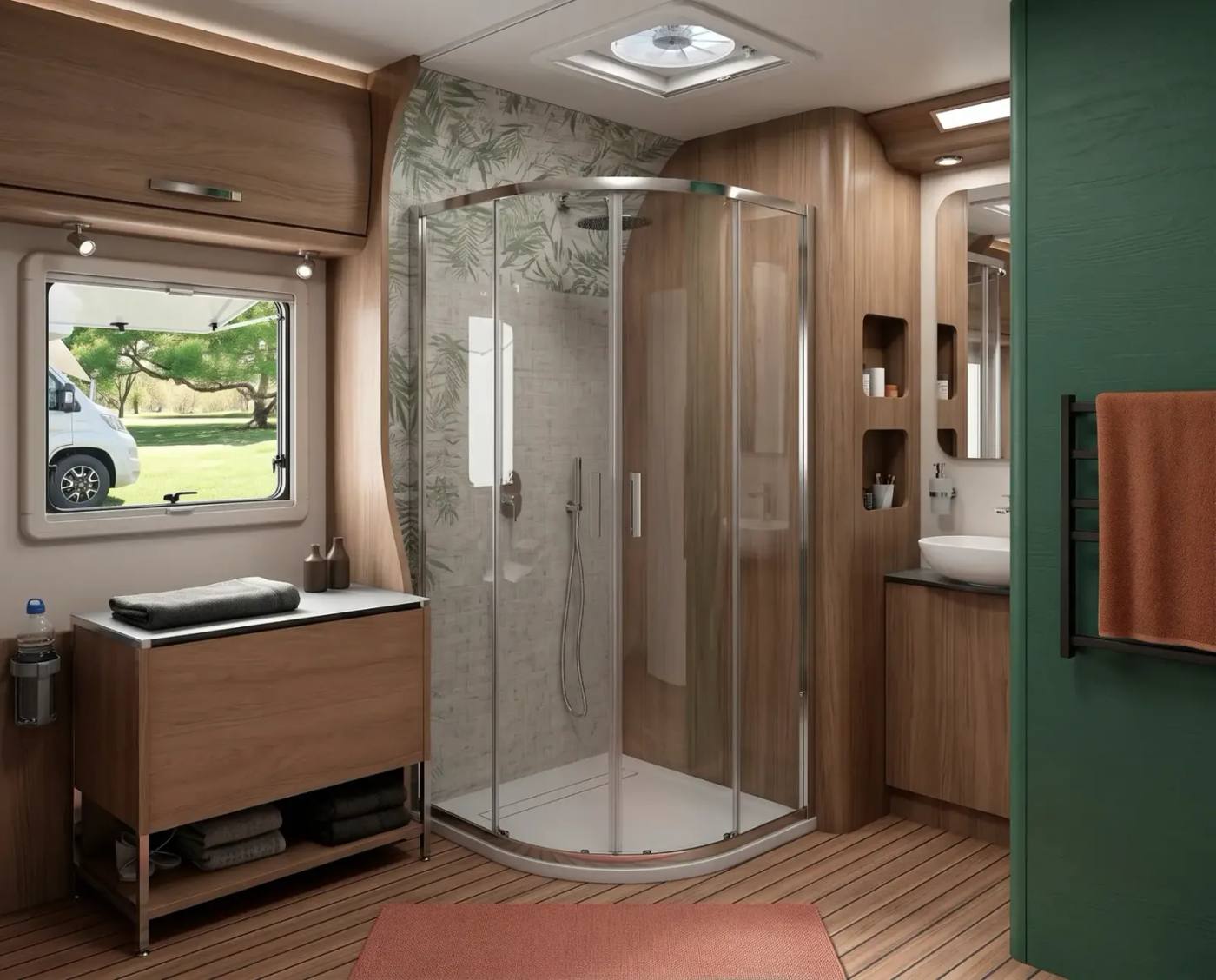
In a motorhome the shower space rarely exceeds one square metre, and every centimetre counts. Choosing the right motorhome shower tray is not just a question of size: it has to be lightweight, withstand the vibrations of travel and avoid adding watertightness problems in a space that is constantly on the move.
Anyone fitting out or refurbishing the bathroom of their motorhome or campervan often faces the same question: will a standard shower tray from a DIY store do, or do you need something designed specifically for a motorhome? The answer is almost always the latter. In this guide you will find out how to choose a made-to-measure motorhome shower tray, which materials cope best with life on the road and what to check before you order.
What is a motorhome shower tray and how does it differ from one for the home?
Unlike a shower tray for a house or flat, a motorhome tray has to deal with constraints that simply do not exist in a home bathroom: weight limited by the vehicle’s payload, space that follows the curves of the living area, and a surface that must remain stable while the vehicle is moving on the road.
Many production motorhomes are fitted with shower trays in ABS or thin plastic, designed to keep weight and manufacturing costs down. They do the job, but after a few seasons they tend to flex under load, fade in the sun and scratch easily. A made-to-measure motorhome shower tray in a sturdier material solves these problems from the outset, with dimensions designed for the space actually available rather than a generic standard.
Motorhome shower tray sizes: dealing with non-standard spaces
Here the challenge is different from a home bathroom. The shower compartment of a motorhome is almost always irregular in shape, with one wall following the curve of the bodywork or an electrical column eating into the usable space in one corner.
The most common sizes range from 60×60 cm in the most compact campervans up to 90×70 cm in larger motorhomes, but cutting to size is often the only practical route when the space is not a perfect rectangle. CSA has spent years designing shower enclosures for motorhomes that adapt to the curves and internal obstructions of vehicles, and the same approach applies to the tray: first the actual space is surveyed, then the tray is cut to fit it, not the other way round.
The best materials for a motorhome shower tray: lightness above all
Weight is the first selection criterion for any component that goes on board a motorhome, and the shower tray is no exception. A motorhome shower tray in composite resin weighs a fraction of an equivalent in porcelain stoneware or natural stone, which translates directly into less weight carried and less stress on the floor structure.
Resin has another advantage on the road: it absorbs the small vibrations of travel better than a rigid material such as ceramic, which can crack at its support points over time. Textured anti-slip finishes, now available even on the most compact models, help keep you steady when the motorhome floor is never completely still, for example when parked on a slope.
If you want an even lighter solution, consider reinforced fibreglass versions, which are also widely used in the marine sector for the same reasons: minimal weight and resistance to salt water and temperature swings.
Made-to-measure motorhome shower tray: when a custom cut makes sense
If the motorhome’s shower compartment does not match standard sizes, which is the most common situation, having the motorhome shower tray cut to measure becomes the most sensible choice, rather than forcing a production model into a space it was never designed for.
CSA brings to the design of motorhome shower trays the same expertise gained in designing shower enclosures for yachts, where every centimetre of space on board must be used without waste and every piece must follow the real curves of the hull. The principle is the same: survey the space, cut to measure, check watertightness before delivery.
If you are also considering the enclosure walls, not just the tray, the dedicated page on CSA motorhome shower enclosures presents complete solutions for fitting out the vehicle’s bathroom, from the tray to the profiles and the glass.
Replacing the motorhome shower tray in an existing fit-out
If you are not fitting out a new motorhome but need to replace a damaged or worn motorhome shower tray, you face a different problem from someone starting from scratch: the space is already defined by the existing structure, and you have to work with the room there is, not the room you would like.
The first step is to remove the old tray and check what is underneath before ordering anything. Under a tray that has been in place for years, you may find a worn waterproofing membrane or a floor panel slightly swollen from past leaks that were never noticed: in that case it is better to fix the problem before laying the new tray, not afterwards.
Measurements must be taken on site, not taken from the model declared by the motorhome manufacturer: over the years the interior layout may have been modified, or the original tray may have been slightly smaller than the available space to allow for factory assembly tolerances. Height matters too: a motorhome shower tray much higher or lower than the previous one can create a step with the floor of the living area, or complicate the connection to the existing waste.
In most cases the motorhome is off the road for a few days for the replacement, between removal, any work on the substrate and allowing the silicone to cure before using the shower again: a technical downtime to factor in, especially if the work has to be fitted in before a trip that is already planned.
Installation and watertightness: how to avoid leaks on the road
In a motorhome, a water leak does not stay confined to the bathroom: it can reach the floor of the living area and, from there, the wood or plywood of the structure, causing damage far more costly than a shower tray replacement.
That is why the perimeter seal of the tray needs even more care than in a home bathroom, using a silicone specifically designed for environments subject to vibration and frequent temperature changes; otherwise it loses its elasticity and cracks sooner than expected. The waste also deserves attention: it must be sized for the vehicle’s grey water tank, which is often smaller than a domestic drain, to prevent water from pooling during the shower.
Looking after your motorhome shower tray on your travels
A motorhome shower tray is cleaned just like one at home, with a neutral detergent and a non-abrasive sponge, but with one extra precaution: after every trip it is worth checking the joints and the perimeter seal, because road vibrations can open up micro-cracks over time that are not always visible to the naked eye.
Before a long winter lay-up, dry the tray thoroughly and leave the motorhome bathroom slightly ventilated: residual moisture in a space closed up for months is the most common cause of mould and unpleasant smells when you start travelling again.
Motorhome shower tray: the checklist before you order
Before choosing, it is worth checking four points:
- the actual space of the shower compartment, measured precisely rather than estimated by eye
- the weight of the material, in relation to the payload still available on the vehicle
- the perimeter seal and the waste, sized for the grey water tank
- whether a made-to-measure cut is needed, if the space is not a standard rectangle
A made-to-measure motorhome shower tray solves the space, weight and watertightness problems in one go, something a production model rarely manages to do all at once. If you are also considering the rest of the shower enclosure, the CSA motorhome shower enclosures page shows the full range of bespoke solutions for your vehicle’s bathroom.
FAQ
How much does a motorhome shower tray weigh compared with a traditional one?
In composite resin it generally weighs less than half as much as a ceramic or porcelain tray of the same size, a decisive factor for anyone who has to stay within the vehicle’s payload.
Can a motorhome shower tray be cut to measure for an irregular space?
Yes, and it is the most common solution when the shower compartment follows the curve of the bodywork or is reduced by a service column. Cutting to measure avoids wasted space and sealing problems at the edges.
How often should the seal on a motorhome shower tray be checked?
At least once a season, and in any case after every long trip on rough roads, because vibrations can weaken the perimeter silicone before a leak becomes visible.