Japandi Style Bathrooms: Minimalist Shower Enclosures and Stone-Effect Trays

When Japan meets Scandinavia in the bathroom
There is an aesthetic that, over the past few years, has won over architects, interior designers and homeowners with a quiet, unstoppable force. It doesn't shout, it doesn't show off, it doesn't dominate. It asserts itself through stillness, through a rigorous choice of materials, through an almost meditative care for every detail. It's called Japandi, and it is the fusion of Japanese aesthetic sensibility — with its reverence for the essential, for emptiness, for nature — and Scandinavian design, with its devotion to comfort, function and warm, organic materials.
The Japandi style bathroom is perhaps the domestic space where this philosophy finds its fullest expression. By its very nature, the bathroom is a space of transition and ritual: we wake up in it, we get ready, we cleanse ourselves. It is the space of self-care, of mindful slowness. And that is exactly what Japandi celebrates.
In this article we'll explore every element that makes up a Japandi style bathroom, with particular attention to the shower enclosure — in its most minimalist versions — and to the stone-effect shower tray, one of the material symbols of this aesthetic approach.
The core principles of a Japandi style bathroom
Before we talk about products and solutions, it helps to understand the deeper principles that guide a Japandi style bathroom. Applying them superficially — scattering a few decorative pebbles and propping some bamboo on the edge of the basin — isn't enough. Japandi is a philosophy before it is an aesthetic.
Wabi-sabi: the beauty of imperfection
The Japanese concept of wabi-sabi is fundamental to a Japandi style bathroom. It means finding beauty in imperfection, in the unfinished, in things worn by time. In practical terms, in the bathroom this translates into a preference for materials with irregular textures, matt surfaces, stones with unique veining, timber with knots. Not the industrial perfection of glossy white, but the authenticity of raw material.
Lagom: the right balance
On the Scandinavian side, the Swedish concept of lagom (not too much, not too little) guides decisions about proportion. In a Japandi style bathroom this means avoiding both decorative excess and oppressive austerity. The space should be furnished with what is genuinely needed, chosen with care and placed with intent.
Function and beauty as one
In Japandi there is no separation between beautiful objects and useful ones. Every element of the bathroom — from the soap dish to the shower head, from the tray to the enclosure — should be beautiful because it is well made, not because it is decorated. Build quality is part of the aesthetic.
The colour palette of a Japandi style bathroom
Understanding the colour palette is the first step in designing a Japandi style bathroom properly. It isn't a striking palette, but a scale of tones that echo nature in its quietest moods.
Off-whites and cream: not the clinical optical white of a hospital kitchen, but warm whites like milk, ivory and limestone.
Stone greys: from a near-white pale grey to a mid anthracite. The greys of basalt, slate and washed concrete.
Beige and sand: the shades of pale terracotta, wet sand and natural linen.
Moss and sage green: small natural accents that bring organic life into the space. Used sparingly, as plants or decorative inserts.
Light and mid-tone timber: the white-beige of ash, the yellow of bamboo, the warmth of European walnut. Never lacquered, always natural or oiled.
Within this palette, a Japandi style bathroom absolutely avoids saturated colour, excessive contrast, and tones that are too bright or too cold.
The minimalist shower enclosure: essential architecture
In the design of a Japandi style bathroom, the shower enclosure is not an accessory: it is an architectural element. And as such, it deserves to be treated with rigour.
The walk-in as the quintessential Japandi form
The walk-in shower enclosure — with its fixed glass panel, its absence of doors, its transparency — is the form that best embodies a Japandi style bathroom. It is the least visually intrusive, the cleanest structurally, the one that keeps the presence of metal to a minimum and lets the material (stone, concrete, timber) on the walls take centre stage.
In a walk-in configuration for a Japandi style bathroom, the ideal glass is extra-clear (with light transmission above 91%, without the green cast of standard float glass), toughened and, ideally, free of chemical anti-limescale coating: Japandi favours the simplicity of cleaning by hand and of authentic material.
Profiles: which to choose
A Japandi style bathroom calls for profiles that don't impose themselves yet still have presence. The ideal choice is between:
Brushed stainless steel: understated, durable, free of any colour cast. It's the most neutral option, suited to Japandi bathrooms with a cool palette (greys, whites, concrete).
Dark brushed bronze or brass: for the warmer versions of Japandi, where timber and beige tones lead. Antique brass or burnished bronze add that touch of organic warmth without shouting.
Matt black: the most graphic choice, suited to more contemporary, urban takes on a Japandi style bathroom. Matt black draws the perimeter of the glass like a line of sumi-e (Japanese ink calligraphy).
Gold or shiny profiles are best avoided: too showy for Japandi sensibility.
Glass thickness and construction details
In a Japandi style bathroom, even glass thickness matters. An 8 mm pane has a very different physical presence from a 6 mm one: more solid, more material, more "present". For a quality Japandi walk-in we recommend 8 or 10 mm glass, which gives the enclosure an almost sculptural solidity.
Hinges and fittings, where visible, should be kept as discreet as possible: the Japandi philosophy rewards the hidden construction detail, the invisible joint, the minimum of exposed hardware.
The stone-effect shower tray: the floor that changes everything
If the shower enclosure is the vertical architecture of a Japandi style bathroom, the shower tray is its foundation. And in the Japandi philosophy the floor is an element of primary importance: it is what connects the space to the earth, to nature, to the body that moves across it.
The stone-effect shower tray is the most coherent choice for a Japandi style bathroom for a number of deep-seated reasons.
Texture and tactility
Japandi celebrates tactility. A smooth, glossy shower tray is the opposite of what this philosophy asks for. A tray with a stone-effect surface — slate, basalt, quartzite, brushed concrete — brings a sense of contact with nature underfoot, an authenticity of material that is exactly the kind of sensory experience Japandi wants to evoke.
Colours and variants
In a Japandi style bathroom, the most fitting stone-effect trays are:
Basalt or slate grey: the most Japandi of them all. It recalls the stone of Japanese mountains, the pebbles of a zen garden, Nordic granite.
Stone white or limestone white: for bathrooms with a bright palette, where you want to keep the material texture without weighing things down chromatically.
Sand beige or pale clay: for the warmer versions of Japandi, paired with timber and natural elements.
Dark anthracite: for bathrooms with a pared-back, very rigorous palette, where the tray is part of a system of graded greys.
Materials: composite resin or porcelain stoneware?
In the context of a Japandi style bathroom, the choice between a composite resin tray and a porcelain stoneware tray isn't purely technical: it is also aesthetic and philosophical.
Porcelain stoneware with a stone effect often looks excellent, with textures that are very faithful to natural stone. For the shower, though, it has one drawback: the grout lines. In a Japandi setting that aims for purity and simplicity, grout lines are a visual disturbance and a maintenance burden.
Composite resin (mineral marble, solid surface, composites) offers seamless, monolithic surfaces with increasingly convincing stone-effect textures. Its ability to be made to measure is an enormous advantage in showers of unusual dimensions. A stone-effect resin tray is often the most coherent solution for a Japandi style bathroom because it combines visual authenticity with constructional purity.
The other elements of a Japandi style bathroom
Sanitaryware
In Japandi the WC and bidet — where present — are preferably wall-hung, in very clean oval or rectangular shapes. Matt white is preferred to gloss. The most Japandi basins are the countertop type, in ceramic or natural stone, with organic rather than geometric forms.
Vanity unit and timber
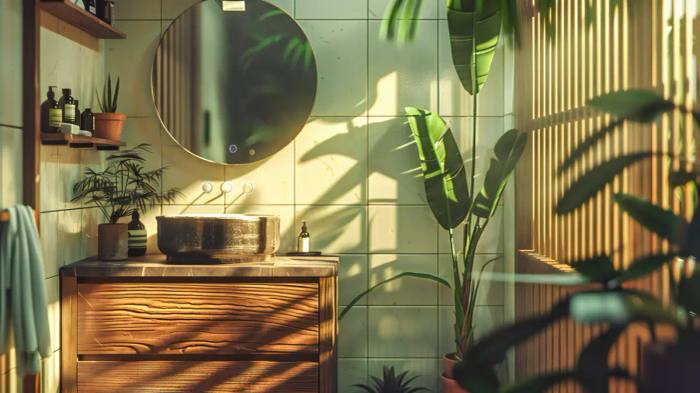
The vanity unit is where timber finds its strongest expression in a Japandi style bathroom. Natural oiled wood, never lacquered, in light or mid-tone species. The contrast between the warm material of the timber and the cool stone of the countertop basin is one of the most powerful pairings of this style.
Lighting
Light in a Japandi style bathroom should be diffuse, never harsh or pinpointed. The ideal solutions are warm white LED strips (2700-3000K) recessed into the ceiling or set behind translucent panels, for light that wraps around you without dazzling. Backlit mirrors fit perfectly, provided the light isn't cold or neon.
Accessories: less is more
The Japandi philosophy demands a rigorous selection of accessories. Every element in a Japandi bathroom has to earn its place. A soap dish in concrete or stone, towels in raw linen or organic cotton, one or two plants — a weeping fig, a ZZ plant, a dwarf olive tree — to introduce a touch of green without overcrowding.
Mistakes to avoid in a Japandi style bathroom
Too many different materials: Japandi rewards material coherence. Three or four materials at most, chosen with care and repeated across the space.
Glossy, shiny surfaces: Japandi is matt, textured, brushed. Mirrored surfaces belong to other styles.
Saturated colours: an orange tray or a cobalt-blue wall instantly breaks the Japandi balance.
Too many decorative pieces: in a Japandi style bathroom, every decorative object must have a function or a deeper reason. The ornament for its own sake has no place.
Overly high-tech equipment on show: Japandi prefers to conceal technology. Taps with futuristic joysticks or hyper-technical shower enclosures with built-in light fittings break the purity of the language.
Conclusion: the bathroom as a place of daily ritual
A Japandi style bathroom isn't a passing trend. It is the design answer to a deep need for slowing down, for authenticity, for the mindful wellbeing that defines our time. A Japandi bathroom isn't simply "looked at": it is lived in, felt underfoot (the stone tray), breathed in the air (essential oils, natural timber), appreciated in the visual silence of essential forms.
At CSA Box Doccia we offer minimalist walk-in enclosures and stone-effect shower trays that are perfect for this aesthetic approach. Carefully chosen materials, discreet profiles, build quality you can feel. Because even the daily shower can be a small ritual of beauty. Get in touch with us today!