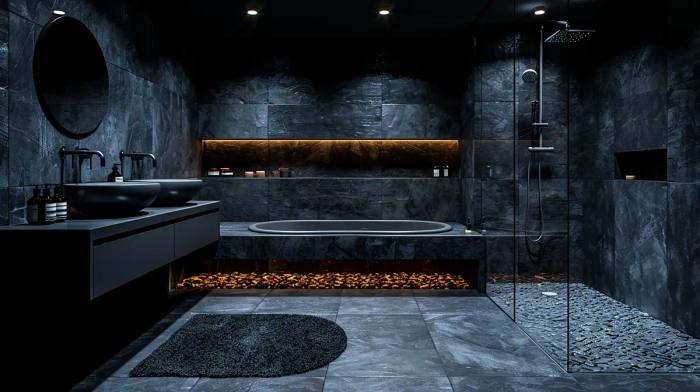
Modern dark bathroom: how to manage limescale on black shower trays and profiles

Choosing a bathroom in a modern dark scheme means accepting a trade-off. You give up the easy upkeep of white and gain a look few other styles can match: depth, restraint, a quiet sense of luxury. The catch is that limescale on a black surface isn't as forgiving as it is on white. Quite the opposite: it shows every single time.
White marks on an anthracite shower tray or on matt black profiles are the number-one complaint from people who choose this finish. Not because black is a fragile coating, but because nobody explained how to look after it.
Why a modern dark bathroom shows limescale more than others
Limescale is calcium carbonate: a greyish-white deposit that forms wherever water evaporates and leaves its minerals behind. On a light surface the contrast is low. On a black or anthracite shower tray, every drop that dries badly leaves a mark you can spot from across the room. Matt finishes then tend to hold limescale more than glossy ones, because the microscopic texture of the surface gives the mineral particles more to cling to.
It gets trickier because many modern black profiles, including the frames of matt black shower enclosures, are treated with powder coating or PVD. These finishes are tough, but not indestructible: harsh or abrasive products damage them for good, leaving micro-scratches that go on to trap even more limescale.
With hard water and matt black finishes, drying down after every shower isn't optional. It's the difference between a bathroom that always looks good and one you have to scrub every week.
The difference between fresh limescale and ingrained scale
Not all limescale deposits are treated the same way, and mixing them up is one of the most common mistakes. Fresh limescale, the kind laid down in the last few hours or a day at most, comes off with a damp cloth and a light pass of diluted vinegar or a pH-neutral cleaner. No harsh products needed.
Ingrained scale, the sort that builds up over weeks with no intervention, is another story. It's hard, it has bonded with the surface, and it needs a product made specifically to dissolve it. This is where citric acid comes in, the best compromise between effectiveness and care for black finishes. It works, it doesn't scratch, and it won't attack the coating the way industrial hydrochloric-acid descalers do.
IMPORTANT: Before using any acidic product on black profiles or coloured shower trays, always test on a small hidden area first. Some coatings, especially the cheaper ones, react badly even to concentrated citric acid.
Which products are safe and which to avoid in a modern dark bathroom
Product choice is where most people go wrong. The market is full of powerful descalers, many of them formulated for white ceramic surfaces and with no regard for matt or treated finishes. Using them on a black profile risks dulling it further, stripping the finish or leaving whitish marks that never come off. Read more here!
Quick product guide
Diluted citric acid (5-10%): highly effective, safe on black finishes. The starting point for almost every case.
Diluted white vinegar: moderately effective, safe. For light deposits, not for ingrained scale.
Dedicated pH-neutral cleaner: moderately effective, very safe. For daily upkeep.
Supermarket descaler spray: highly effective, risky for finishes. Often contains hydrochloric acid.
Bleach or chlorine products: useless on limescale and terrible for finishes. Always avoid.
Abrasive sponges or scouring pads: scratch matt surfaces beyond repair. Never use them.
How to clean a black shower tray: a practical method
For a dark-coloured resin or mineral-cast shower tray, the most effective routine for moderate scale is this: make up a solution of powdered citric acid dissolved in warm water, at 50 grams per litre. Apply it with a soft microfibre cloth, leave it to work for ten minutes without letting it dry, then rinse with plenty of water and dry straight away with a clean cloth.
For the more stubborn spots, especially the edge of the tray where water pools, you can raise the concentration to 100 grams per litre and repeat. Never leave citric acid on composite resin for more than 15-20 minutes: prolonged acidity can interfere with the surface treatment.
Tools to use
A fine-weave microfibre cloth, a soft brush for corners and edges, a cotton towel for the final dry. Nothing else. The simplicity of the kit is part of the technique, not a shortcut.
Black profiles: different care from the tray
Matt black shower enclosure profiles are, along with the taps, the parts of a modern dark bathroom most prone to deterioration if they aren't treated properly. PVD or powder-coated finishes stand up well to knocks and damp, but not to concentrated acids and abrasives.
For profiles, the weekly routine matters more than any deep treatment. Wiping with a cloth lightly dampened with diluted white vinegar (one part vinegar to three parts water) after every shower, or at least every other day, stops limescale building into hard scale. If you live in a very hard-water area, consider a periodic protective treatment with a wax made for matt black surfaces: it creates a barrier that makes deposits harder to stick.
Water hardness: understanding where you live
Not every home has the same problem. In hard-water regions, which cover much of the South and East of England, a modern dark bathroom needs almost mandatory weekly upkeep. In soft-water areas the interval stretches and the whole thing becomes far less demanding.
You can check your water hardness by contacting your local water company or using a test kit from a DIY shop. Hardness is measured in milligrams per litre of calcium carbonate (or in degrees). Above roughly 250 mg/L, treat your dark bathroom as high-risk for limescale and act accordingly, perhaps even looking at fitting a water softener downstream of the meter.
What to do when the damage is already done
If you're faced with very heavy scale, widespread dulling or marks that resist citric acid, your options depend on the material. On a resin or mineral-cast tray, a longer cycle with concentrated citric acid (up to 150 grams per litre), worked in small sections with a damp cloth kept wet for no more than 15 minutes, sorts most cases.
On coated profiles, though, if the finish has gone dull or patchy, there has probably been earlier chemical damage. In that case no product will bring back the original finish: the only route is replacing the profiles or a professional re-coat. Which is exactly why it pays to invest in the right products from the start.
Choosing a shower enclosure for a modern dark bathroom: what to weigh up
If you're designing the bathroom or weighing up a new enclosure, bear in mind that not all black finishes behave the same. Profiles with a physical PVD (Physical Vapour Deposition) finish are more resistant than plain powder coating: harder, more scratch-resistant, and better able to cope with repeated contact with mild acids. They cost a little more, but the effect on longevity is significant.
The type of glass matters too, especially for upkeep. Glass with a water-repellent (anti-limescale) treatment greatly reduces deposits forming on the surface. In a bathroom with dark walls, spotlessly clean clear glass is part of the look: keeping it perfect isn't just about care, it's about visual consistency with the design.
A modern dark bathroom asks for more attention than a traditional one, but it's attention that comes down to simple actions, repeated with a bit of consistency. It has nothing to do with complexity. It has everything to do with being aware of what you've chosen.
Want to dig into other aspects of your walk-in shower? On the CSA Box Doccia blog you'll find articles on glass, finishes, sizes and much more: everything you need to design a bathroom that lasts.