Crystal glass shower enclosures: what it means, finishes and how it compares with acrylic
Anyone shopping for a crystal glass shower enclosure sooner or later runs into a contradiction. Crystal, the kind used for wine glasses and chandeliers, is heavy and delicate. A shower screen, on the other hand, has to withstand knocks, temperature changes and years of daily cleaning. The two don't go together, and in fact in the bathroom the word "crystal" has a meaning of its own.
Understanding it helps you read product sheets properly, compare quotes and avoid being misled by anyone offering acrylic (plexiglass) as an equivalent alternative. Then comes the more enjoyable part: choosing the finish, which changes the look of the shower far more than you might expect.
What "crystal" means in a shower enclosure
In Italy the word "crystal" is defined by law. Law 827 of 1973, which transposes the European directive 69/493/EEC on crystal glass, reserves the name "lead crystal" for glass containing at least 24% lead oxide, and "full lead crystal" for glass reaching 30%. These are materials made for tableware and decorative objects, not for a humid room exposed to constant stress.
When a manufacturer talks about a crystal shower enclosure, it means something else: toughened safety glass, a glass panel that has been heat-treated so that it becomes far more resistant to impact and, if it breaks, shatters into small blunt granules instead of sharp shards. In the bathroom industry, "crystal" has become the name for this higher-grade glass, clear and free of optical defects. Lead has nothing to do with it.
CSA uses exactly this term in its product sheets, listing the "crystal thickness" of every model. How toughening works and why it changes the way glass behaves is explained in our guide to tempered glass for shower enclosures. Here, the practical point is enough: a serious crystal shower enclosure is always made of toughened glass.
Toughened crystal shower enclosures: the guarantees to check
A name on a product sheet is not enough. The real guarantees are two standards. The first is EN 14428, which sets the requirements and tests for domestic shower enclosures and allows CE marking. The second concerns the glass itself: the EN 12150 family, which defines thermally toughened safety glass. All the details on tests, marking and the Declaration of Performance are in our guide to shower enclosure standards.
The other figure to look at is thickness. Glass in the CSA range goes from 3 to 8 mm, depending on the model and the type of opening. Choosing the right thickness for your layout is a topic of its own, covered in our guide to shower glass thickness.
Crystal glass or acrylic shower enclosure?
An acrylic shower enclosure costs less and weighs less, which is why it keeps turning up in quotes. It is worth understanding what you gain and what you lose. First, a note: "Plexiglas" is the trade name of polymethyl methacrylate (PMMA), but in everyday speech it ends up meaning almost any clear plastic panel.
Weight and sturdiness
PMMA weighs about half as much as glass. In a motorhome or a rarely used guest bathroom that can be an advantage. In a home shower, though, the weight of the glass means stability: the door slides without rattling and the panel doesn't flex when you touch it. It's a difference you notice every morning.
Scratches, limescale and cleaning
Plastic is much softer than glass. An abrasive sponge or a few grains of sand are enough to leave marks, and micro-scratches trap limescale. Some cleaners containing alcohol or solvents can also damage the surface. Crystal glass holds up better, cleans with a squeegee and can be given an industrial anti-limescale treatment, as we explain in our article on anti-limescale shower glass.
Clarity over time
A crystal glass shower enclosure stays clear for years if it is cleaned regularly. A plastic panel, instead, tends to turn cloudy precisely because of the scratches that build up. The result is a bathroom that ages faster than the rest of the furniture.
When acrylic makes sense
To be fair, an acrylic shower enclosure is not wrong in itself. For a temporary solution, a very tight budget or a vehicle where every kilo counts, it does its job. For a bathroom you want to live in and show off for ten or fifteen years, crystal glass is the choice that pays off. That is why CSA works only with toughened glass across its whole range.
Crystal glass finishes for shower enclosures
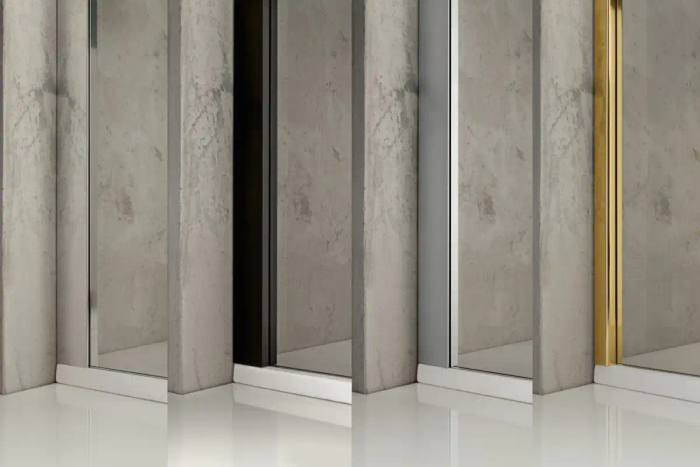
This is where a crystal shower enclosure stops being purely technical and becomes a style choice. Let's take as an example the Kalea N.FS alcove shower enclosure, with 6 mm glass and a sliding door: it is one of the CSA models with the widest range of colours.
Clear and extra-clear
Clear is the classic version, the one that makes the bathroom look bigger. Extra-clear goes one step further: ordinary glass, seen edge-on, has a slight green tint caused by the iron in its raw materials. Extra-clear glass contains much less of it and gives a neutral white, perfect with light tiles and marble.
Satin and grey satin
Satin glass is frosted: it lets light through without showing the figure behind it. It is the simplest answer for anyone sharing the bathroom or with a shower facing the door. Grey satin adds a bolder, more contemporary touch.
Grey and bronze
The tinted versions, grey and bronze, stay see-through but filter the view and add character. They work well with black or nickel profiles and with dark wall finishes. If you can't decide between tinted and neutral glass, our comparison of smoked or clear glass shower enclosures sets out the pros and cons, maintenance included.
Grey Stopsol
Stopsol is glass with a reflective coating applied to its surface. From one side it looks semi-mirrored, from the other it stays more transparent. It gives privacy without the milky effect of satin glass.
Mirror effect
The mirror finish is the most striking. On Kalea it is available among the special colours, and it turns the shower screen into a piece of furniture that reflects light and visually doubles the space.
Where the glass changes the design
The same crystal shower enclosure behaves differently depending on the layout. In an alcove it works on one side only, and the finish becomes the "front" of the shower. In corner shower enclosures there are two glass sides, so extra-clear glass makes it feel much lighter, while satin glass on both sides can close in a small room too much.
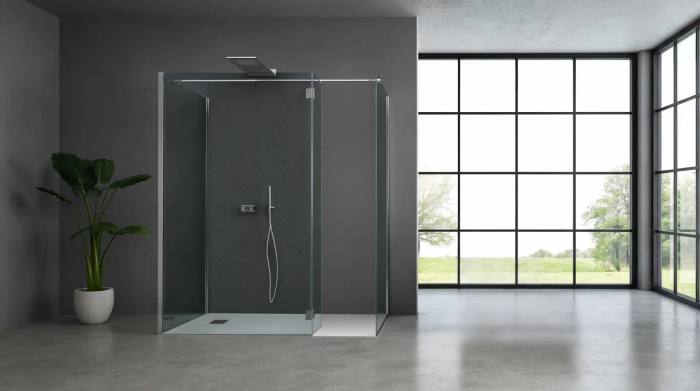
In a walk-in, the glass is the real star. The Sabrina W.D walk-in from the steel line, for example, is a large 8 mm panel with stainless steel profiles: no doors, no handles, just glass. In an open shower like this, the quality of the glass and the choice of finish stand out more than in any other model.
See the glass in person
Photos only go so far. The difference between clear and extra-clear, or between satin and grey satin, really comes across only when you hold the sample in your hand under the light of your own bathroom. For retailers, architects and interior designers, CSA has put together the Material Box, a free kit with the catalogue, samples of the aluminium and steel finishes and the glass. If you're renovating your own home, ask your CSA retailer to show you the samples before you confirm the order.
FAQ
Does a crystal shower enclosure contain lead?
No. Lead crystal is a material for decorative objects. A crystal shower enclosure is made of toughened safety glass that complies with the industry standards.
Can a toughened crystal shower enclosure break?
Like any glass, it can break under very strong impact, especially on the edges. Toughening means it shatters into small, low-risk granules instead of shards.
Crystal glass or acrylic for a small bathroom?
For a small bathroom, a clear or extra-clear crystal shower enclosure is the best choice: it stays clear over time and lets all the light through, while acrylic tends to turn cloudy.
Choosing a crystal shower enclosure means choosing a screen that still looks good after thousands of showers. The rest is personal taste, and with eight colours available on Kalea there's room to find the right one.