Shower Enclosure Sizes: Standard and Made to Measure

When it comes to designing a bathroom, looks play a crucial part, but it is function that sets the rules of the game. At CSA Box Doccia we see it every day: customers in love with a design who have not reckoned with the real space. Understanding the correct shower enclosure sizes is the pillar on which a comfortable, safe and durable room is built.
We are not simply talking about filling a gap in a corner. It is about calculating volumes, manoeuvring room, door swing and internal ergonomics. In this technical deep-dive we explore every aspect of measurements, helping you find your way between market standards and bespoke options, to avoid mistakes that could prove costly at the installation stage.
Standard shower enclosure sizes: the market landscape
The bathroom market has evolved enormously, but there are still "canonical" sizes that cover most domestic needs. Knowing these shower enclosure sizes lets you see straight away whether your project falls into a standard category (cheaper and quicker to source) or calls for a bespoke approach.
The main classification is based on the shape of the shower tray fitted.
Sizes for a square footprint
The square is the most traditional shape for shower enclosures. It is the favoured choice for cloakrooms or for making the most of compact corners.
- 70x70 cm: often seen as the entry-level size for a functional bathroom. Compact but adequate.
- 80x80 cm and 90x90 cm: here we are in the most popular shower enclosure sizes. 80x80 is the king of the standard market, while 90x90 offers that bit of extra room that makes the difference when moving about, letting you lather up without bumping into the walls or the taps.
Rectangular enclosure sizes
The current trend shows a clear preference for rectangular shapes, often used to replace old baths. Rectangular shower sizes offer more internal room. Among the most common combinations are:
- 70x90 cm and 70x100 cm: excellent for narrow, long bathrooms.
- 80x100 cm, 80x120 cm up to 80x140 cm: these are the dimensions that start to define a "statement" bathroom, where the showering zone takes centre stage.
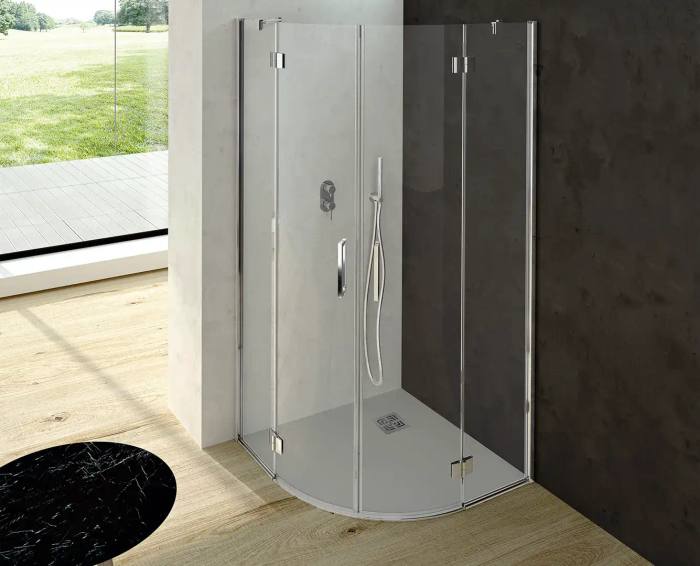
Quadrant shower enclosure sizes
For anyone needing to recover circulation space outside the shower, the quadrant is unbeatable. The classic sizes are 80x80 cm and 90x90 cm. Be aware, though: here, alongside the straight sides, the curve radius comes into play (usually R55), a key technical figure for the compatibility of the enclosure with the tray.
Measuring up for shower enclosure sizes: how to avoid mistakes
The moment of truth is taking the measurements. An error of a single centimetre can make installation impossible. As professionals, we suggest never trusting nominal sizes ("I bought an 80x80 tray"), but checking the real centimetres in situ.
To establish the correct shower enclosure sizes, you need to measure the distance from the tiled (finished) wall to the outer edge of the shower tray. Here is a working checklist:
- Measure at three heights: take the width at the bottom (on the tray), at mid-height (around 100 cm) and at the top (around 190–200 cm).
- Check for out-of-plumb: if the walls are not perfectly vertical, the enclosure size will vary. If the recess narrows at the top, you must work to the smaller measurement; if it widens, you need to consider the profile's adjustment range.
- Allow for adjustability: our products always have a margin of adjustment (e.g. 2–3 cm) to compensate for irregularities. If your space is 78 cm, an enclosure with a 77–79 cm adjustment range is perfect.
Shower enclosure sizes and height: the vertical evolution
Until a few years ago, the standard height was fixed at 185 cm. Today, shower sizes have grown upwards. The modern demand settles around 195 cm or 200 cm. This choice is not purely cosmetic (it elongates the bathroom and makes it more elegant), but also technical: shower heads are often fitted higher than in the past, or even ceiling-mounted. A taller enclosure ensures better water containment.
That said, weigh up the vertical shower enclosure sizes carefully if you have:
- Low ceilings or suspended ceilings with downlights.
- A water heater above the shower.
- Windows that intersect the shower area. In these cases, you may need to order an enclosure with a reduced or shaped height.
The relationship between the door and shower enclosure sizes
Not every door type suits every size. The choice of opening system (sliding, hinged, concertina) is intrinsically tied to the shower enclosure sizes of your space.
Sliding doors
These need a minimum width to ensure easy entry. On a 120 cm side, a sliding door is perfect (entry around 50–55 cm). On a 70 cm side, a sliding door might leave a usable opening of only 35–38 cm, often too narrow for larger-built people.
Hinged (door)
Ideal for maximising the entry, but constrained by the space outside. If you choose generous enclosure sizes but have the basin or WC right in front of the shower, the hinged door could strike the sanitaryware.
Concertina and bi-fold
When shower enclosure sizes are critical (tiny recesses, cramped bathrooms), the concertina is a lifesaver. It folds the door inwards, leaving almost the whole opening clear for access.
Large shower enclosure sizes: the world of the walk-in
In design refurbishments, the fixed walk-in panel is booming. Here the notion of size changes. We are not closing off a space, but marking out a zone. For a functional walk-in, the shower enclosure sizes of the glass range from 70 to 160 cm. The golden rule we suggest at CSA Box Doccia is to calculate the tray depth carefully:
- You need an entry space of at least 50–60 cm.
- You need a total tray depth of at least 120–140 cm to stop splashes reaching the basin or the towels.
If your bathroom allows you to fit "extra large" shower enclosure sizes, the walk-in is the most hygienic and long-lasting solution, with no moving parts or complex seals.
Small bathrooms: what are the minimum shower enclosure sizes?
We are often asked: "How small can a shower enclosure be?". Technically, trays as small as 60x60 cm exist. However, we strongly advise against these shower enclosure sizes unless it is an emergency situation (e.g. bathrooms on boats, campervans or extreme under-stairs spaces). The minimum size for washing with a bit of dignity and ergonomics is 70x70 cm. Going below this threshold means knocking your elbows with every movement.
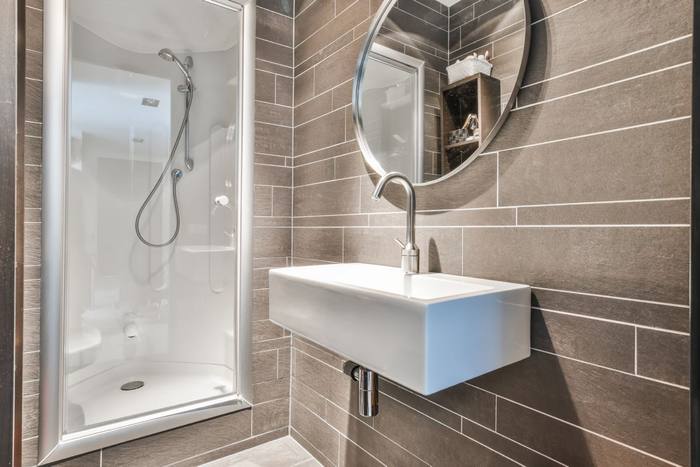
If space is tight, it is better to work on the shape: a 70x90 cm rectangle steals just 20 cm more on one side but radically changes the experience compared with a 70x70 square. You can read more in our article Shower Solutions for Small Bathrooms.
Profiles and glass: their bearing on shower enclosure sizes
A detail often overlooked is the thickness of the materials. When you plan the recess to the millimetre, remember that the external shower enclosure sizes include the profiles. A "frameless" enclosure (no profiles) with 8 mm glass has different overall dimensions and fixing systems than an aluminium model with 4 mm glass.
Furthermore, the compensation profiles (those fixed to the wall) have a width of their own. If you have to fit the enclosure near a window or a door, check that the profile does not overlap the door architrave or the window handle. Consulting the technical data sheets on our site is essential to verify the true footprint of the floor profile.
When to choose made-to-measure shower enclosure sizes?
There are contexts where standard is not enough.
- Low kerbs inside the shower.
- Sloping loft ceilings.
- Trays cut on site or with irregular flush-to-floor edges.
In these cases, forcing a standard product is a mistake. Bespoke shower enclosure sizes are our daily bread. Making the glass to the millimetre guarantees not only a clean look but, above all, watertightness. A standard enclosure poorly adapted will demand tonnes of silicone that, over time, yellows and lets water through.
The importance of precision
Why do we insist so much on shower enclosure sizes? Because the shower is a wet environment, subject to thermal swings and wear. An enclosure of the wrong size works under strain: the rollers wear sooner, the seals do not meet properly, the magnets do not close. Investing time in accurate measuring means investing in the lifespan of your bathroom.
At CSA Box Doccia we are on hand to guide you. Whether it is working out if an 80x100 will fit, or designing a complex glass screen, analysing the dimensions is the first step towards satisfaction. Contact us today!
FAQ: Frequently Asked Questions
Here are the answers to the most common queries our customers raise day to day.
What sizes do showers come in? Sizes vary widely by shape. The standard squares are 70x70, 80x80 and 90x90 cm. For rectangles, the most frequent combinations are 70x90, 70x100, 80x100 and 80x120 cm. There are also made-to-measure solutions that can cover almost any dimension a customer requires.
What features should a good shower enclosure have? It must ensure stability and safety (toughened or laminated glass), have an adjustment system to adapt to out-of-square walls, and use moisture-resistant materials such as anodised aluminium or stainless steel. A good enclosure should also be easy to clean, ideally with anti-limescale treatments on the glass.
How do you choose a shower enclosure size? You need to weigh up the available space, allowing for the door's swing and the circulation in front of the shower. It is important to choose a size in proportion to the bathroom: neither so large it smothers the room, nor so small it becomes awkward to use.
How do you measure up to buy a shower enclosure? Measurements are always taken after the wall covering is laid. Measure the distance from the tiled wall to the outer edge of the shower tray. Take the width at three points (bottom, centre, top) to check whether the walls are straight. Use the smallest measurement if the enclosure goes into a recess, or consult us for corner situations.
What to know before buying a shower enclosure? Before buying, it is essential to know: the exact dimensions of the installed tray, the type of installation (recess, corner, three-sided), the presence of windows or kerbs that could hamper fitting, and the curve radius in the case of quadrant trays.
What is the smallest shower enclosure? The smallest standard shower enclosure is 70x70 cm. Models of 60x60 cm exist for extremely tight spaces, but they offer very limited comfort. For small spaces, it is often better to opt for narrow rectangular shapes (e.g. 70x80 or 70x90) that offer more breathing room.
What is the standard width of a shower door? The door width depends on the total width of the enclosure. To ensure comfortable access, the usable opening (clear entry width) should never be less than 40–45 cm. On enclosures with a hinged door of 70 cm or more, the opening is almost total.